

Charles Molele
DA’s interim leader John Steenhuisen on Tuesday severely criticized President Cyril Ramaphosa, and stopped short of calling him a false prophet and a weak leader.
Speaking in Parliament during a live debate on Ramaphosa’s state of the nation address, Steenhuisen said Ramaphosa’s time in government has moved from a ‘New Dawn’ to a new period of despair.
“And that will be your legacy: the man who dared us to dream, but led us into a nightmare,” said Steenhuisen.
“You are not the reformer South Africa thought you were … Instead of a New Dawn, there’s a new despair. Through your actions and your decisions these past two years you might have strengthened your internal position – and you may have strengthened the tripartite alliance – but you have hurt the people of South Africa.”
Steenhuisen launched a further attack on Ramaphosa, saying under his leadership the South African economy has ground to a halt, foreign direct investment (FDI) is down, jobs are being lost in their thousands and “municipality after municipality fail, leaving desperate communities without water, toilets or usable roads”.
“We have seen the return of load-shedding, and the need to add even more stages to accurately reflect the fatal condition of the state-run Eskom,” said Steenhuisen.
“Since you delivered your first SONA speech in this House two years ago, well over a million more people have joined the ranks of the unemployed. This number now stands at almost 10.4 million working-age South Africans.”
However, the worst was yet to come for Ramaphosa, who sat quietly next to his wily deputy, David ‘DD’ Mabuza, who watched every move as his boss was ripped apart by opposition parties.
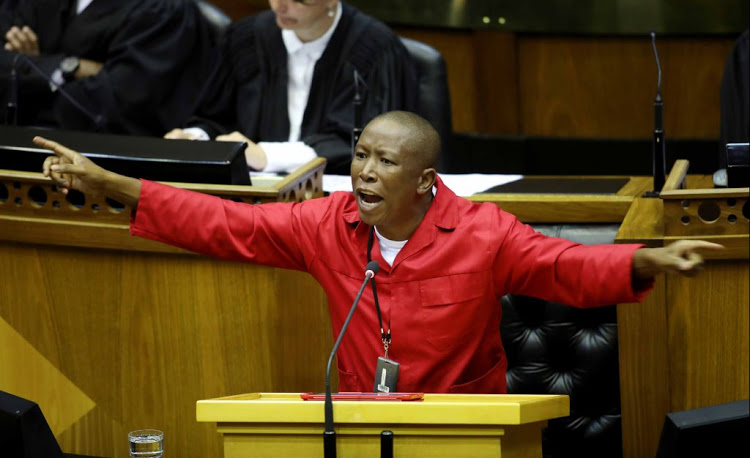
Another blistering attack came from Economic Freedom Fighters leader Julius Malema, who criticized Ramaphosa for pursuing ‘neo-liberal policies’ dictated to by white monopoly capital, a reference to powerful South African CEOs and dollar billionaires such as Johan Rupert, Nicky Oppenheimer and Michiel Le Roux.
“Comrade President, you have not created any jobs. Since you became President, unemployment has increased in this country. Instead of being a president that creates jobs, you’re a president that has created unemployment. More young people are unemployed now than they were before you became a President,” Malema told the house.
“President, when you delivered your first State of the Nation Address in February 2018, we said we are willing to give you a chance. In February 2019, we told you that your proposals are dangerous and will make you enemy number one of the EFF, workers and the poor masses. We also warned you that if you are not willing to be decisive to change property relations and want to continue with your cowardice, and wanting to make friends with everyone. We told you that you have abandoned politics and you put profit and greed above all.”
While Malema continued with his scathing speech, an intemperate ANC MP Boy Mamabolo interjected, asking Malema to address allegations that he has been abusing his wife, Mantwa Malema.
An angry Malema went ballistic with characteristic bluster, dragging Ramaphosa into the sensitive debate, saying the president beat up his late former wife and former Chairperson of the Telkom Board, Nomazizi Mtshotshisa.
Malema said Mtshotshisa shared harrowing stories of her abuse at the hands of Ramaphosa with then ANC deputy president Jacob Zuma.
“President Zuma can confirm that Ramaphosa used to beat his wife. I have never, not once; not my ex, not my wife. I never laid a hand on my wife,” said Malema, responding to Mamabolo’s question.
“When I spoke here during the SONA debate last year, anyone who has never beaten his wife in the past 25 years must raise his hand and I said I can do that because I have no history of such things. I asked that question precisely because I got information that the President used to beat his wife Nomazizi. May her soul rest in peace.”
Irate ANC MPs stoop up to challenge Malema’s claims, accusing him of unfairly besmirching Ramaphosa’s name and undermining efforts to deal decisively with gender-based violence in South Africa by throwing around untested allegations.
Malema stood his ground, but later left the house after NCOP chairperson Amos Masondo asked him to leave the house for refusing to retract his statement and apologize to Ramaphosa.
Meanwhile, Minister in the Presidency, Jackson Mthembu, commended Ramaphosa for delivering an inspirational speech with clear time-bound targets.
“Let me take this opportunity to congratulate President Cyril Ramaphosa on delivering what was nothing short of an inspiring State of the Nation Address. Many South Africans have characterised the 2020 SONA as a pointed and honest appraisal of Government’s work with clear time bound targets,” said Mthembu.
“The speech focused on the Seven Apex Priorities of Government addressing urgent issues facing the nation such as the energy crisis, youth unemployment, growing the economy and building a capable state. We welcome Government’s plan to ensure that Eskom works to restore its operational capabilities, while implementing measures that will fundamentally change the trajectory of energy generation in our country such as putting in place measures to enable municipalities in good financial standing to procure their own power from independent power producers.”
Mthembu said when Ramaphosa came into office in 2018 he set an ambitious target of attracting R1.2 trillion in investments in South Africa over a period of five years.
“We have in the first two years of our investment drive, raised a total of R664 billion in investment commitments, which is more than half of our five-year target of R1.2 trillion. Mr President, in your address during SONA 2019, you announced that government will be setting up an Infrastructure Fund to address the infrastructure backlogs we are faced with,” said Mthembu.
“To this end, Government has set aside R100 billion over a decade to co-finance programmes and projects that blend public and private resources, with R10 billion in the baseline for the next three years. To date, the implementation unit for the Infrastructure Fund has identified possible projects and programmes amounting to more than R500 billion.”