

REBECCA HAYNES|
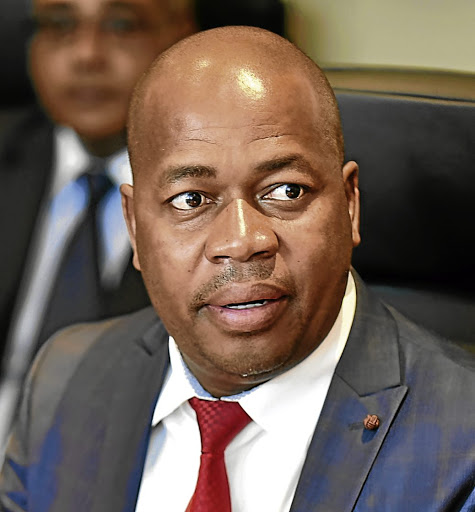
CITY Of Ekurhuleni mayor Mzwandile Masina has made economic recovery as one of his key priorities to counter the devastating effects of the COVID-19 pandemic.
Masina also used his last State of the City Address in the chamber to also reflect on achievements of the past five years.
He was elected as the new mayor of the City of Ekurhuleni in 2016 – and his term comes to an end later this year during the 2021Local Government Elections.
Not only does the current administration’s term of office come to a close soon, but this is also the 20th anniversary of the forming of the city.
Key sectors among his economic recovery plan include agriculture and manufacturing projects aimed at creating job and empowerment opportunities.
These projects include the 30-year Aerotropolis Master Plan, ACSA expansion, developments along the R21 Corridor that since 2016 has already seen an R800-million investment in bulk infrastructure, and investments in the OR Tambo International Airport Industrial Development Zone.
Agricultural reform was also highlighted by the mayor, mentioning the agricultural Farm Release programme in place with 11 successful bidders and another 45 farms in the wings.
“Also, from 2016 to date, the city has facilitated the implementation of strategic urban development with an estimatedR80-billion already unlocked. Another R7-billion facilitated the implementation of the strategic economic zone,” said Masina.
Masina stressed the urgency that government at all levels begin to reconstruct the economy.
The city is responding with its Post Covid-19 Economic Reconstruction and Recovery Plan. The theme of his address was ‘usheringin an era of renewed commitment and unity towards rebuilding a people-centered post-Covid economy’.
This, for a city that is the manufacturing and logistics hub of sub-Saharan Africa, means creating a conductive environment for the productive capacity of the city and its people.
“We have invested efforts to systematically drive programmes to position the city as the primary anchor and footprint of the provincial economy,” continues Masina. “We have been working together with private sector on large-scale development projects to promote industrialisation and catalytic projects that are essential ingredients to turn the tide on our ailing manufacturing sector.”
Integral to recovery is support of SMMEs through public procurement and the city’s Enterprise Development programme which includes mentorship, incubation and innovation.
“Our efforts in skills development have improved the employment prospects of the youth, something we have implemented in collaboration with the private sector,” said Masina. The city has appointed over 6 332 young people to the work readiness programme and internships and created more than 26 000 work opportunities through the Expanded Public Works Programme (EPWP). In addition, since 2016, 935 informal enterprises were registered or issued with trading licenses or permits.
“It is our view that at this time of great need, our macro-economic interventions must talk to the needs of our people, particularly the poor and the vulnerable. It must talk to businesses of all sizes as they drive the economy and create much-needed jobs that provide livelihoods,” Masina concluded.
In his final address on Wednesday, Masina also stressed that despite battling the aftermath presented by a COVID economy, there have been real achievements over the years.
“This State of the City Address takes place at a rather extraordinary time when the world is dealing with COVID-19,” said Masina.
“The pandemic has been psychologically and economically bruising for our country. Its devastation has been felt both in our homes and our national economy. In a year, the country experienced a sharp decline in growth and a significant increase in unemployment resulting in rising poverty levels and deepening inequality. In the third quarter of 2020, our economy dropped by 6% compared to the same period in 2019 and almost two million South Africans lost their jobs. Our unemployment rate now stands at a staggering 30.8%.”
“The pandemic meant additional strain to municipal revenues and collection rates. For instance, our city was forced to adjust the budget downwards from an approved MTREF Capex of R7.4-billion in the previous financial year to R4.9-billionin the coming financial year – a move that has a massive impact on the city’s infrastructure delivery programme.”
- Inside Metros