

By Johnathan Paoli
The DA has praised the strides its municipalities have made towards energy independence and highlighted ongoing projects designed to reduce reliance on Eskom and secure affordable, sustainable electricity for South Africans.
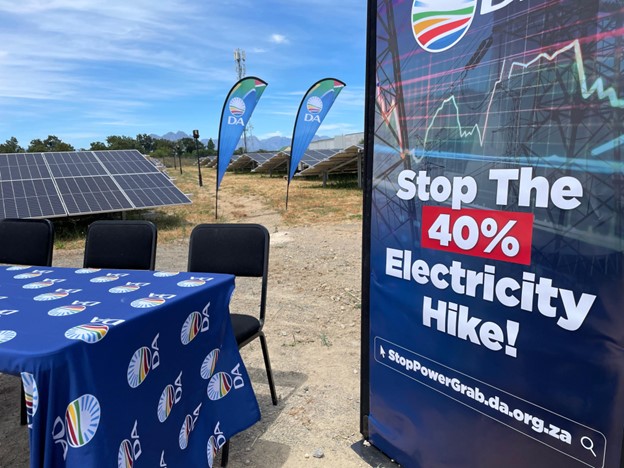
During a media briefing at the Kraaifontein Wastewater Treatment Plant in Cape Town on Thursday, DA Federal Council chair, Helen Zille stressed the reality of most of the country’s citizens’ inability to afford the increasing cost of electricity.
“We cannot afford a 40% price hike. It would devastate households, stifle economic growth, and push more businesses into the red. It is crucial that we fight this increase and explore sustainable alternatives to Eskom’s monopoly on power,” she said.
Zille, accompanied by the DA national spokesperson Karabo Khakhau, and mayors from DA-run municipalities in Cape Town, Overstrand, Midvaal, and Drakenstein delivered a briefing following the preparation of the National Energy Regulator of South Africa on Eskom’s proposed tariff increase for 2025.
The country’s state-owned electricity supplier has requested a substantial 40% hike in prices, which the DA has strongly opposed.
NERSA has approved a 4% increase to enable Eskom to collect an extra R8 billion from consumers to make up for revenue losses.
The party claims that such a significant increase would further burden households already struggling with the rising costs of living, potentially forcing millions to choose between paying for electricity or other essential services.
Zille said her party is also taking proactive measures where it governs, working to diversify energy sources and reduce municipalities’ dependence on the power utility.
As part of its efforts to combat Eskom’s price hikes, Zille said her party is making investments in alternative energy solutions and small-scale embedded generation (SSEG), with the city of Cape Town ramping up efforts to source energy from renewable sources like solar power.
She praised the fact that the Kraaifontein Wastewater Treatment Plant is currently powered by a solar energy farm.
This initiative, as part of the city’s broader SSEG programme, is expected to save the city R2.4 million in electricity costs in its first week while generating 1.5 GW of clean energy annually.
Cape Town mayor Geordin Hill-Lewis praised the potential of alternatives sources of power which provides a lifeline tariff that reduces costs for low-income households by up to 44% in order to shield vulnerable residents.
“Cape Town is leading the way in energy independence, proving that local governments can reduce their reliance on Eskom while simultaneously providing clean, affordable power to residents,” Hill-Lewis said.
In addition to solar power, Cape Town is investing heavily in green energy initiatives, managing electricity demand strategically, and supporting local residents in generating their own energy.
This includes encouraging private sector participation in renewable energy production and providing incentives for households to install solar panels.
Midvaal, another DA-run municipality, has formalised plans to procure energy from independent power producers (IPPs) and is currently in the process of developing feed-in tariffs for small-scale energy produces.
Midvaal’s Mayor, Peter Texeira, said that diversifying power sources would help stabilise energy prices for residents; and announced the launching of solar-powered street lighting in various wards, further reducing its dependence on Eskom.
Meanwhile, Overstrand is encouraging SSEG projects in both solar and wind power as part of its broader energy diversification stratification.
Overstrand’s mayor, Dudley Coetzee confirmed the municipality’s intention in transforming its source of power.
“Our focus is on ensuring that we have a more sustainable, diversified energy mix that protects our residents from Eskom’s price volatility,” he said.
In Langeberg, the local government has signed agreements with businesses and individuals to allow excess power generated from private solar installations to be fed back into the municipal grid, reducing not only reliance on Eskom but also helping in lowering energy costs for the community.
Saldanha Bay is pushing forward with plans to create a local electricity generation hub, potentially supplying power to neighbouring municipalities.
Stellenbosch has awarded a 20 MW solar power contract to an IPP and is retrofitting municipal buildings with solar systems and battery storage to protect the municipality.
Mossel Bay is exploring micro-grid projects that will establish municipal-owned electricity generation plants, providing power for key infrastructure and reducing the municipality’s dependency.
Zille said that by fostering local energy generation, municipalities are not only protecting their citizens from Eskom’s price hikes but also contributing to a more sustainable and resilient national energy system.
“We will continue to push forward with these initiatives, ensuring that where the DA governs, residents will have access to affordable, reliable and clean energy for years to come,” Zille said.
She said the DA’s growing network of energy resilience projects offers a glimpse of a more sustainable and independent energy future for South Africa.
INSIDE METROS