

By Thapelo Molefe
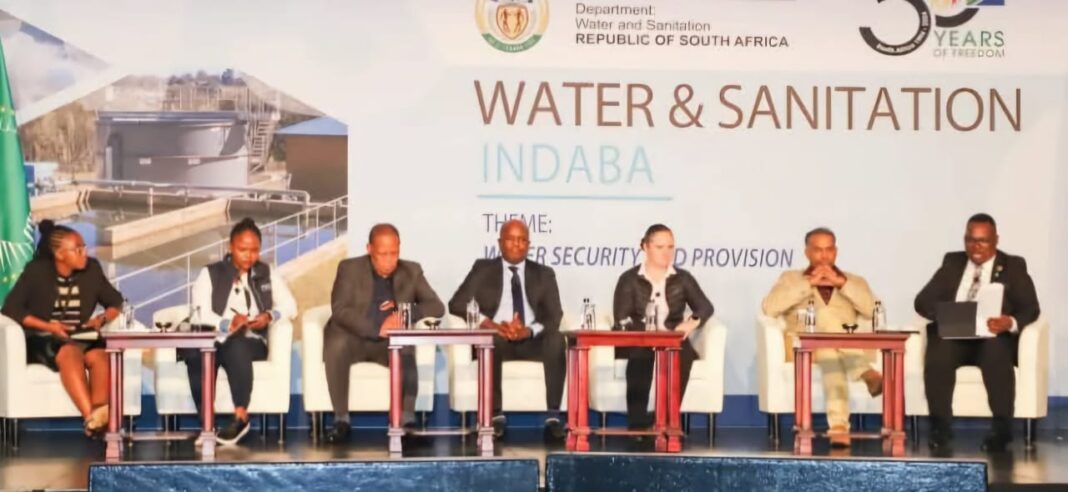
Experts at the Water and Sanitation Indaba, held at Gallagher Convention Centre in Midrand, laid bare challenges facing municipalities, including ineffective grant utilisation leading to funds being returned to the National Treasury due to procurement and planning delays.
They said municipalities struggle to generate sustainable revenue due to issues such as illegal water connections, theft, and inadequate billing systems.
Water and Sanitation Deputy Minister David Mahlobo, one of the speakers at the water indaba, also pointed out these concerns, warning about the shrinking municipal revenue base caused by illegal activities like water theft from dams and reservoirs.
“People are taking water from the dams illegally, from the reservoirs illegally, doing illegal coalitions,” said Mahlobo.
The issue of illegal water sales by rogue operators was a major concern.
Delegates also emphasised the urgency of accurate metering and billing systems to ensure financial stability.
Proposed solutions included integrating billing systems with Eskom to minimise revenue loss and enhancing law enforcement efforts against water theft.
Another critical challenge identified was the difficulty smaller municipalities face in attracting and retaining skilled water engineers, as competitive salaries and better conditions in metropolitan areas draw technical expertise away.
To counter this, delegates recommended developing strategies to retain talent, including utilizing retired experts and forming partnerships with universities and skills development bodies.
Strengthening Public-Private Partnerships (PPPs) was also cited as crucial for creating an environment conducive to investment.
Proposed strategies included exploring various service delivery models like concessions, fast-tracking amendments to the Water Services Act, and improving water board efficiency for better accountability.
Asset management and digitisation were also key focus areas, with poor asset management contributing to aging infrastructure and service failures.
Delegates advocated for adopting digitised systems to enhance operational efficiency and data accuracy, alongside rigorous monitoring of municipal asset management practices.
Delegates also acknowledged that crime, including theft and vandalism of infrastructure, poses a significant obstacle to water service delivery in municipalities already grappling with numerous challenges.
In his presentation, Deputy Director-General in the Department of Water and Sanitation, Xolani Zwane, opened with a blunt acknowledgment that inefficiency and mismanagement in municipalities must be overcome.
“Municipalities need to take their water business as their business,” said Zwane.
Meanwhile, Water and Sanitation Minister Pemmy Majodina urged Premiers and Executive Mayors to adopt water-conscious budgets to help the government meet its commitments.
She noted that many Water Services Authorities (WSAs), including some metros, are failing to fulfill their constitutional obligations.
According to Majodina, water reliability and supply have deteriorated, with the country’s top 100 municipalities showing poor performance across all provinces.
To address these challenges, the Department will launch a roadshow to engage Premiers, MECs, Executive Mayors, and their municipal executives. Reports on municipal performance and planned interventions will be presented during these meetings.
INSIDE METROS