

By Johnathan Paoli
In a milestone event for data-driven governance and local economic development, Gauteng MEC for Finance and Economic Development, Lebogang Maile has officially launched the province’s first-ever Municipal Economic Review and Outlook (MERO), in an effort to redefine how local governments across Gauteng plan, budget, and deliver services to residents.
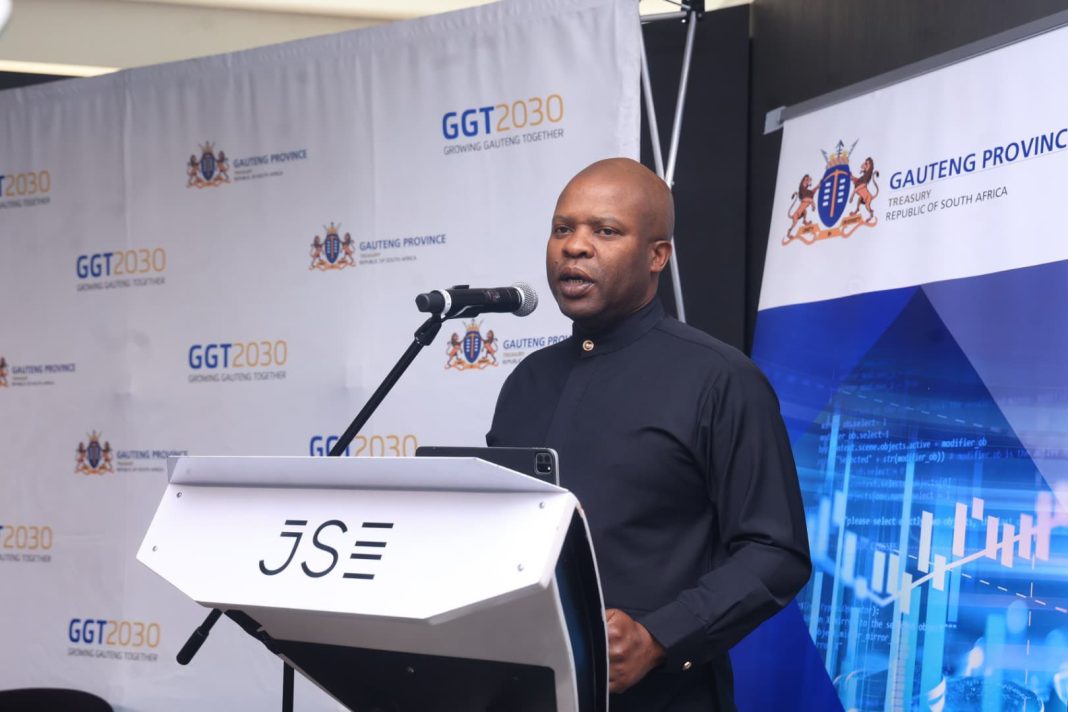
Speaking during the launch of Gauteng’s inaugural Municipal Economic Review Outlook held at the Johannesburg Stock Exchange (JSE), and developed in collaboration with global consultancy Ernst & Young, Maile emphasised MERO’s central role in enabling evidence-based policy-making and creating a platform for sustainable, inclusive development across Gauteng’s municipalities.
“This launch is not just the release of a document. It is a declaration that we are entering a new era of data-driven governance, where decisions are guided by scientific evidence, not assumptions. Planning must be at the centre of Gauteng’s development, and by extension, the development of South Africa and the continent,” Maile said.
The MERO is an in-depth economic intelligence report that analyses socio-economic conditions and trends in all municipalities within the province.
It is the first of its kind to provide a province-wide, municipal-level economic snapshot, encompassing data on Gross Domestic Product by region (GDPR), employment, inequality, poverty, education, health, housing, infrastructure, and crime.
Gauteng, South Africa’s economic powerhouse, contributes approximately a third of the country’s GDP and 7% of Africa’s total economic output.
As home to 16.4 million people, over a quarter of South Africa’s population, it is a magnet for global investment and regional migration, and houses major cities such as Johannesburg, Tshwane, and Ekurhuleni.
The MEC said the report is designed to be both a diagnostic tool and a policy guide.
Its granular insights support municipalities in identifying local economic strengths such as high-performing sectors, infrastructure assets, and investment hubs; as well as pinpointing systemic weaknesses, such as underperforming service delivery, high unemployment, or outdated infrastructure.
Crucially, the MERO aligns with the province’s long-term strategy, Grow Gauteng Together 2030, which focuses on transformation, modernisation, and reindustrialisation of the local economy.
Maile stressed that by doing so, it strengthens the link between policy ambitions and operational planning at the municipal level.
The report also contributes directly to national data infrastructure.
The MEC noted that the inclusion of GDPR and employment statistics enhances the South African Revenue Service’s Spatial Tax dataset, a critical tool for fiscal planning and targeted public investment.
The MERO’s release comes at a time when many municipalities are facing intense fiscal pressures, service delivery backlogs, and declining public trust.
Maile stressed that municipalities are the first point of contact for citizens, and that robust data is essential for improving accountability, transparency, and governance.
“The significance of this report extends beyond the Gauteng Provincial Government. It is essential for institutions like SARS, for investors, and for every resident who expects safe, reliable, and responsive local services,” Maile said.
Of particular note is the MERO’s attention to public safety and wellbeing.
In a province struggling with high crime rates and socio-economic inequality, the report assesses the intersection between economic conditions and security, tracking indicators such as poverty levels, educational attainment, housing access, and public health.
The MERO also marks a strong public-private partnership between the Gauteng Provincial Government and Ernst & Young.
As one of the world’s largest professional services firms, EY’s involvement brings technical rigour to the report, drawing on global best practices in economic modelling, fiscal analysis, and urban planning.
“This collaboration with Ernst & Young is not just about a report, but about building a blueprint for institutional partnerships that can drive innovation, investment, and impact,” Maile said, acknowledging Africa Chief Economist Angelika Goliker for her leadership in the project.
He further called for continued cooperation between government, business, academia, and civil society in advancing inclusive growth and revitalising township economies, another key focus of the MERO.
The MERO is expected to serve as a benchmarking tool for municipalities, enabling continuous performance monitoring and fostering peer learning.
It will also guide investment strategy, infrastructure planning, and job creation efforts across the province’s five development corridors.
Maile concluded his address with a call to action to continue to build stronger and better communities in Gauteng, and do so hand-in-hand with all sectors.
As the province enters this new phase, the MEC praised MERO as a cornerstone of its journey toward a resilient, inclusive, and high-performing regional economy.
INSIDE METROS