

By Johnathan Paoli
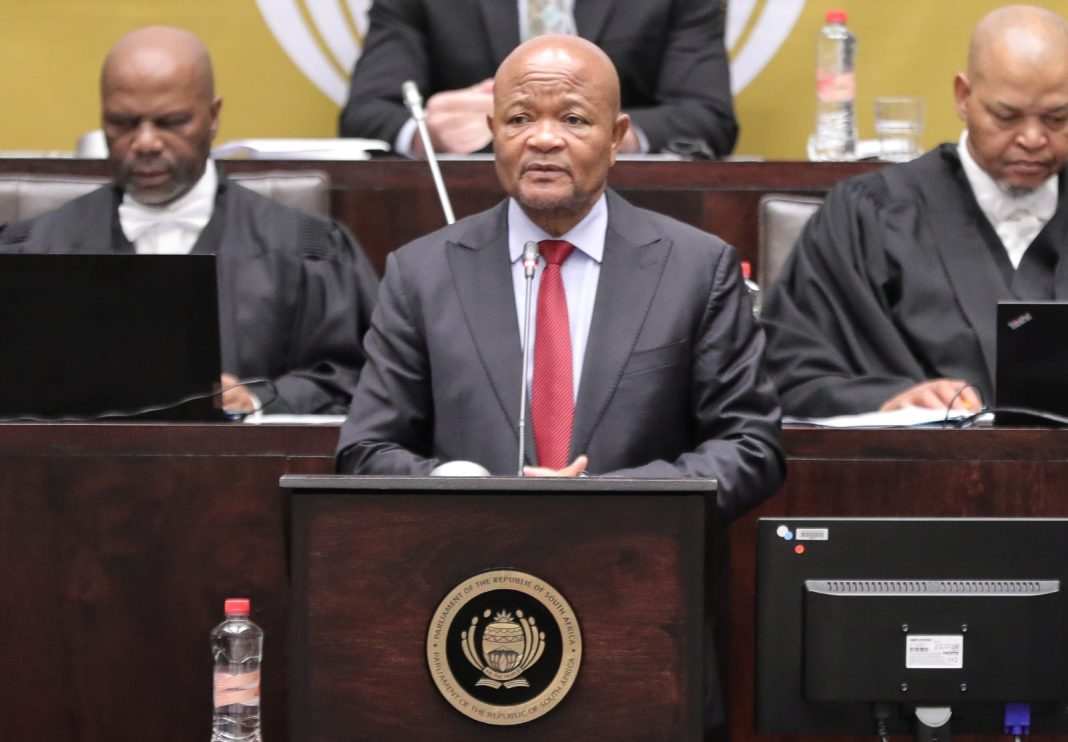
Police Minister Senzo Mchunu has presented his department’s 2025/26 policing budget, reflecting what he says is a commitment to urgency, reform and restoring public safety.
Mchunu tabled the budget in the National Assembly on Friday, outlining a sweeping R120.8 billion allocation aimed at tackling South Africa’s worsening crime crisis.
“We are committed to the realisation of a South African Police Service that is effective, efficient, responsive, and professional. A service that inspires public trust and delivers safety and justice to all South Africans,” the minister said.
Mchunu announced ten policing priorities under four key areas: reducing murder, combating illegal firearms and drug syndicates, intensifying efforts against gender-based violence and femicide (GBVF), and addressing corruption within the SAPS ranks.
Additional focus areas include gang violence, stock theft, illegal mining, cash-in-transit heists, and illegal immigration.
To enable delivery, the minister emphasised five enablers: enhancing technology, bolstering crime intelligence, upskilling detectives, improving forensic services, and modernising infrastructure.
Key allocations from the budget includes R219.2 million for G20 Summit security; R400 million for the 2026 municipal elections; R150 million redirected to the Directorate for Priority Crime Investigation (DPCI or Hawks); R1.6 billion to tackle GBVF, including R1.5 billion for Family Violence, Child Protection and Sexual Offences units; and R670 million for new and upgraded police stations.
Compensation of employees remains the largest cost driver at 81% of the budget, allowing for the enlistment of 5,500 new SAPS trainees in January next year.
The budget, which supports the South African Police Service (SAPS), the Civilian Secretariat for Police Service (CSPS), and the Independent Police Investigative Directorate (IPID), was met with both praise and fierce criticism from across the political spectrum.
ANC MP Erald Cloete endorsed the budget, saying it aligns with the National Development Plan and ANC manifesto priorities.
He highlighted additional funding for DPCI to fight drug trafficking and called for a strengthened national drug master plan.
In contrast, MK Party MP David Skosana condemned the budget as “political theatre at taxpayers’ expense,” slamming SAPS for a 5% rise in the murder rate and its “failure to protect women and children.”
Skosana decried the imbalance in allocations: R72 billion for administration compared to R24 billion for detectives and only R1.7 billion for forensics.
He called for a R10 billion investment in community policing and the recruitment of 30,000 officers.
EFF MP Leigh-Ann Mathys went further, describing SAPS as “the biggest criminal syndicate in this country.”
She claimed SAPS fits the profile of organised crime, citing corruption, political assassinations, and collusion with gangsters.
The EFF rejected the entire budget and demanded sweeping institutional reform, not just increased personnel.
ActionSA MP Molebo Kobe also rejected Votes 28 (SAPS), 21 (CSPS), and 24 (IPID), describing the state as complicit in crime.
She criticised the failure to absorb 180,000 SAPS job applicants and called IPID a “toothless oversight body,” citing the low conviction rate for police brutality.
“Citizens are prisoners in their own homes,” she said.
PA MP Saintes Van Wyk offered conditional support but denounced systemic neglect of coloured, Black, and Indian communities, particularly in the Cape Flats, where 11 people were killed the day before.
He called out the DA for its silence and urged Mchunu to focus resources on high-crime, marginalised areas.
“We will no longer go with empty promises while our people suffer,” he warned.
Deputy Minister of Police, Polly Boshielo, highlighted IPID’s six priorities, including reducing case backlogs and targeting GBVF cases involving police officers.
IPID finalised 92 rape cases in 2024/25, resulting in 21 departmental and 11 criminal convictions.
She announced a new forensic investigation unit, a 24-hour call centre for reporting misconduct, and partnerships with entities like the SIU and SASETA to upskill investigators.
Deputy Minister of Police, Cassel Mathale, defended the CSPS, rejecting accusations of irrelevance and cadre deployment.
He announced the approval of the National Policing Policy and upcoming Police Amendment Bill.
Mathale said the CSPS is central to the Integrated Crime and Violence Prevention Strategy (ICVPS) and is partnering with provinces and metros to enhance police-community relations.
DA MP Ian Cameron offered qualified support, emphasising the need for enforceable integrity.
“Without integrity, no amount of money or vehicles can rescue a broken policing system,” he said.
He called for a parliamentary inquiry into gang violence and condemned the lack of action against corruption at the Philippi Training Academy and within the Private Security Industry Regulatory Authority where R100 million is unaccounted for.
However, Cameron acknowledged recent progress, including SAPS’s forensic capacity expansion, digitised call centres, and proposals to shift toward an intelligence-led, prosecution-driven model.
In his final reply, Mchunu slammed opposition parties’ rejection of the budget as “excessive and unrealistic,” asserting that denying funds would undermine services in their own communities.
He revealed that 85 new DPCI posts will soon be advertised, with 175 more to follow. Additionally, 250 trainees are already being trained for secondment to the Hawks.
To strengthen detective services, 200 retired SAPS detectives are being re-enlisted.
Mchunu also confirmed the imminent opening of a temporary forensic lab in KwaZulu-Natal to relieve Gauteng’s backlog and announced final negotiations with the CSIR for additional forensic capacity.
He concluded by commending the many committed SAPS officers serving the country with “honour and integrity,” calling them a “delight” and urging Parliament to empower and support them.
INSIDE METROS