

By Johnathan Paoli
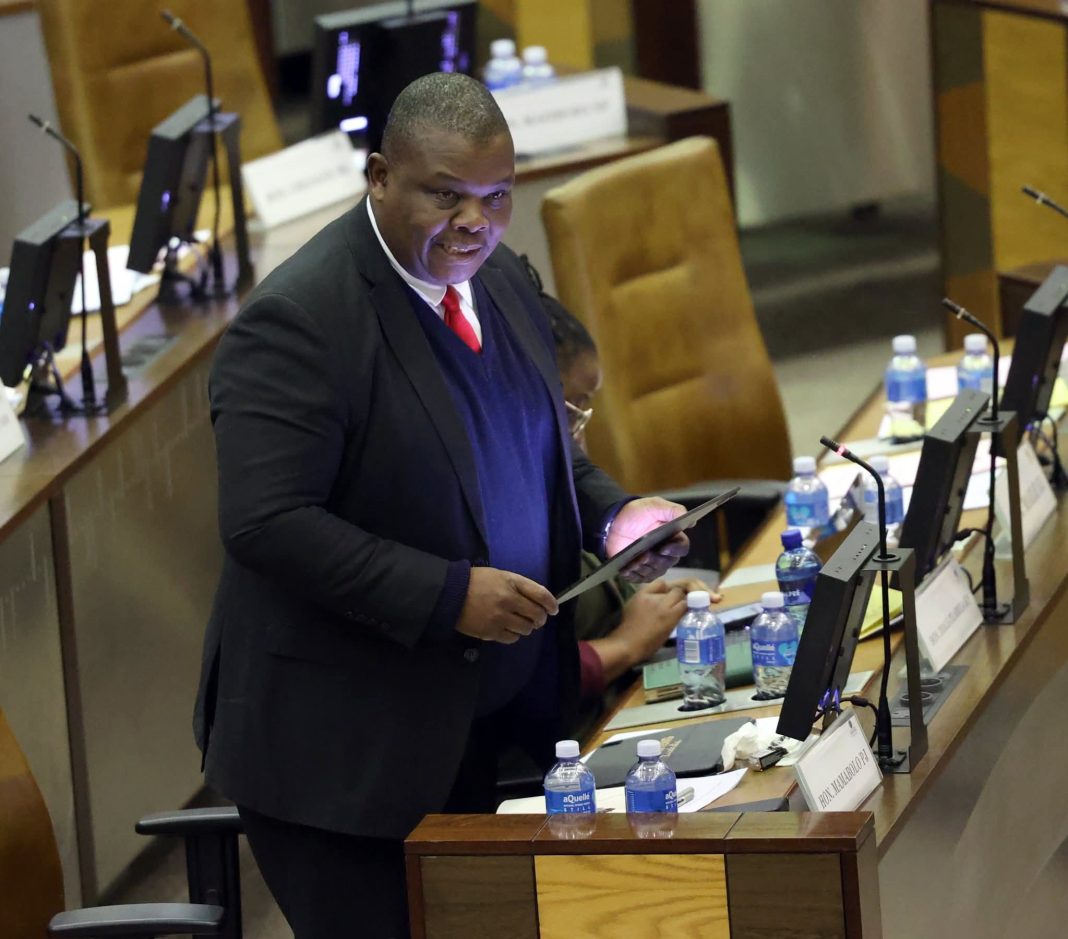
Gauteng Department of Cooperative Governance and Traditional Affairs (CoGTA) MEC Jacob Mamabolo has announced an ambitious roadmap for local governance renewal, smart infrastructure development, and traditional leadership integration, supported by a 2025/26 budget allocation of R551.389 million.
During the budget vote presentation, Mamabolo outlined how these resources, slated to increase to R576 million in 2026/27 and R599 million in 2027/28, will be pivotal in improving municipal operations, enhancing administrative professionalism, and driving comprehensive service delivery reforms.
“The budget supports safer, more responsive communities, builds infrastructure, and empowers traditional and elected leadership alike,” said the department, affirming its goal of a “capable, ethical, and developmental state,” said Mamabolo.
The budget is allocated across four key programmes including R153 million in 2025/26 for administration; R257 million for local governance (municipal support and oversight); R120 million for development and planning (spatial frameworks and smart governance); and R20 million for traditional institutional management.
The funds aim to support CoGTA’s core priorities of revitalising local government, promoting democratic participation through ward councillor training, strengthening traditional councils, and deepening community development.
A major development is the strategic realignment initiated by Premier Panyaza Lesufi, bringing the Department of Cooperative Governance and Traditional Affairs (CoGTA), the Department of Infrastructure Development (DID), and the Gauteng Infrastructure Financing Agency (GIFA) under a single executive authority.
“This realignment is more than structural—it is a transformative governance shift,” said Mamabolo.
The integration enables coordinated infrastructure planning and policy implementation across provincial and local spheres, underpinned by a Smart Cities Strategy aligned with the South African Smart Cities Framework (2021).
The model prioritises technology-driven, citizen-centred, spatially integrated urban development.
The strategy and budget framework revolve around ten priority “Intergrades”: local government turnaround, water and energy security, CBD revitalisation, spatial and social equity, infrastructure development, asset utilisation, township renewal (including Alexandra 4.0 and TISH), waste management, job creation, and digital municipal transformation.
These priorities form the backbone of a new Programme of Action aligning all tiers of government.
The department reaffirmed its preference for Section 154 constitutional support to struggling municipalities, rather than imposing the more coercive Section 139 interventions.
As part of the Gauteng Local Government Turnaround Summit, Mayoral Committee Members are leading workstreams across eight focus areas: governance, finance, service delivery, digitalisation, safety, local economic development, spatial planning, and administrative reform.
All municipalities have completed the Municipal Maturity Assessment Tool, gauging their digital transformation readiness.
Dedicated platforms have also been established to professionalise municipal workforces and reform metro trading services.
The CoGTA budget also supports critical sectoral interventions in water and energy.
Through the Water IGR Coordination Committee, a looming Day Zero scenario was averted through weekly coordination with Eskom, the Department of Water and Sanitation, SALGA, and local governments.
Phase II of the Lesotho Highlands Water Project remains on track for 2028, supported by CSIR-led efforts to digitise water systems.
In the energy sector, collaboration with City Power has driven substation refurbishments and alternative energy exploration.
However, rising municipal electricity debt—particularly in Emfuleni, Tshwane, Rand West, and Merafong—threatens sustainability.
In response, engagements are underway with National Treasury and Eskom.
The weekly Intergovernmental Relations (IGR) system now includes a peer-review mechanism, allowing high-performing municipalities to lead by example.
Ekurhuleni leads on water governance; Johannesburg on waste (Pikitup) and energy (City Power); and Tshwane on integrated law enforcement.
Johannesburg and Tshwane also drive infrastructure initiatives through global G20/U20 platforms.
This includes a landmark MoU on Integrated Law Enforcement, signed at UJ Soweto, enabling joint municipal policing. Operations have been rolled out in Soweto, Emfuleni, Tembisa, and Kagiso.
Despite progress, infrastructure delivery remains hampered by municipal compliance delays—particularly in town planning, land transfers, and occupation certificates.
A newly established Infrastructure IGR structure provides oversight, while GIFA explores innovative municipal financing solutions.
In Emfuleni, the department backed the PhakamaVaal Campaign, deploying infrastructure teams to address service backlogs in Sebokeng, Vereeniging, and Vanderbijlpark.
In Johannesburg, administrative instability has prompted the secondment of Kiba Kekana as Acting City Manager under Section 54A(6) of the Municipal Systems Act.
A former Tshwane official, Kekana’s appointment is aimed at restoring stability and ensuring uninterrupted service delivery.
Traditional institutions will receive R20 million in 2025/26, increasing to R22 million by 2027/28.
This funding supports traditional councils, community development, and the integration of traditional leadership in municipal governance
INSIDE METROS