

By Johnathan Paoli
South Africa’s political landscape continues to shift following a dramatic round of municipal by-elections, which saw critical wins for the Economic Freedom Fighters (EFF), Democratic Alliance (DA), Inkatha Freedom Party (IFP), and African National Congress (ANC) in contested wards across the country.
The by-elections in Limpopo, the Eastern Cape, KwaZulu-Natal and the Eastern Cape were seen as significant tests for major parties as they gear up for the 2026 local government elections.
Voter turnout ranged from 47% to 58%, indicating continued public engagement in local politics despite persistent political fatigue and service delivery frustrations.
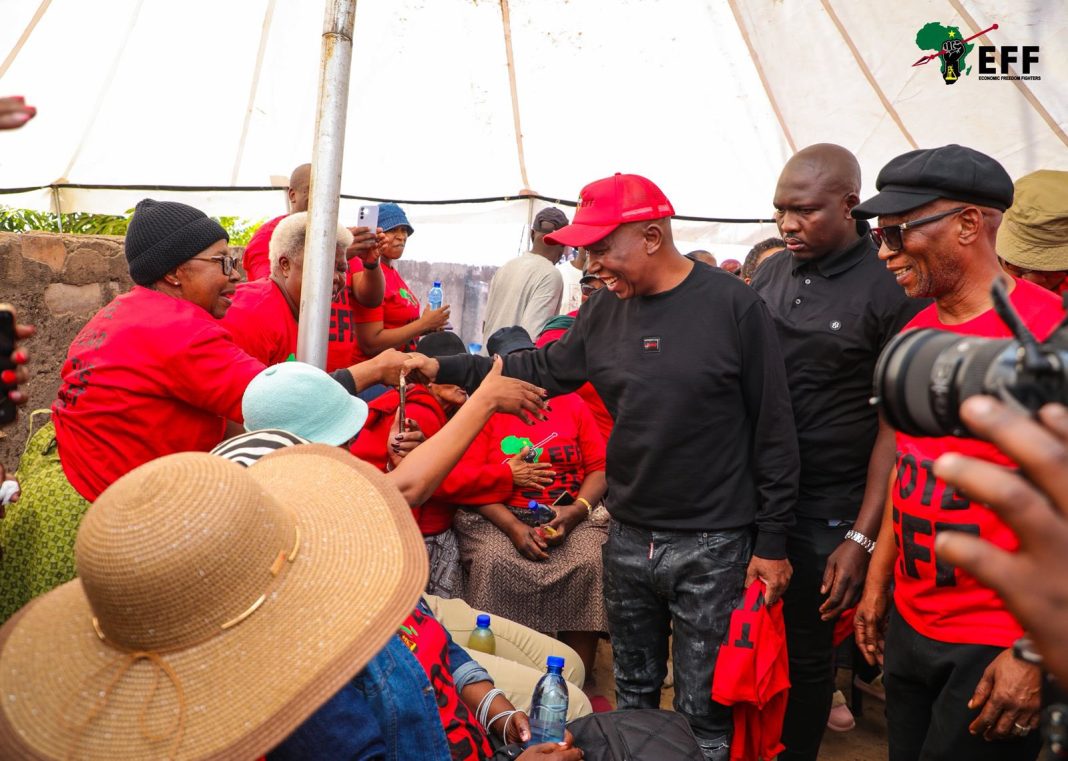
In a symbolic and strategic victory for the EFF, the party comfortably retained Ward 13 in Seshego Zone 1 (Juju Valley) in Polokwane, Limpopo, the home ward of party leader Julius Malema.
The EFF increased its support to 57%, up from 51% in the previous election, defeating the ANC, which trailed with 41%, down from 47%.
The margin of victory was 966 votes, solidifying the EFF’s growing dominance in Limpopo.
The South African Communist Party and smaller parties such as the African Congress for Transformation (ACP) and Labour Party received less than 2% of the vote combined.
Voter turnout was at 51%, a slight increase from 49% previously.
“This victory is a testament to the trust the community places in the EFF to champion their struggles and deliver genuine change on the ground,” the EFF said on X.
In Ward 34 (Arcadia, Bethelsdorp) in the Nelson Mandela Bay Metro, the DA retained the ward but saw its support drop significantly from 62% to 47%.
The Patriotic Alliance (PA) staged a stunning surge, leaping from 3% to 43%, making it a serious challenger in future contests.
The National Alliance saw its support plummet from 18% to 6%, while the ANC and EFF trailed with 2% and 1%, respectively.
This ward in northern Nelson Mandela Bay is considered a bellwether area, and the PA’s rapid rise signals shifting dynamics in coloured and working-class communities.
Despite the pressure, the DA managed to hold onto a vital win in a metro it governs through a fragile coalition.
“The DA wins Ward 34 in Nelson Mandela Bay! The voters have chosen clean governance and a party that delivers,” the party stated on X.
In Ward 23 (Hlobane Kengolana) in AbaQulusi Municipality, Zululand, the IFP secured a solid victory with 51%, up from 42% on the proportional ballot in 2021.
The ANC slipped to 21%, while uMkhonto weSizwe (MK) Party, which had led the 2024 general election in this area with 41%, garnered 19%.
The EFF secured 6%. Notably, the National Freedom Party (NFP), which received 16% previously, did not contest the by-election.
Voter turnout was 55%, up slightly from 53%.
In Ward 11 (Magaba, Mpekweni) in the Ngqushwa Municipality, Amathole District, the ANC scored a resounding victory, taking 70% of the vote, up from 42%.
The Pan Africanist Congress followed with 21%, while Al-Jama-ah claimed 9%.
The ANC now controls all 11 wards in Ngqushwa, effectively giving it full control of the municipality.
Voter turnout stood at 58%, showing strong local engagement.
This round of by-elections showcased both the resilience of established parties and the rising influence of new and smaller political actors.
The EFF’s stronghold in Limpopo, the DA’s defensive success in Nelson Mandela Bay, the IFP’s consolidation in Zululand, and the ANC’s expansion in the Eastern Cape will each factor in upcoming electoral strategies.
The next round of by-elections is scheduled for 14 August.
INSIDE METROS