

By Johnathan Paoli
Ekurhuleni mayor Nkosindiphile Xhakaza has highlighted the importance of political stability in advancing the city’s transformative agenda to build a financially sound, efficient, and responsive metropolitan municipality.
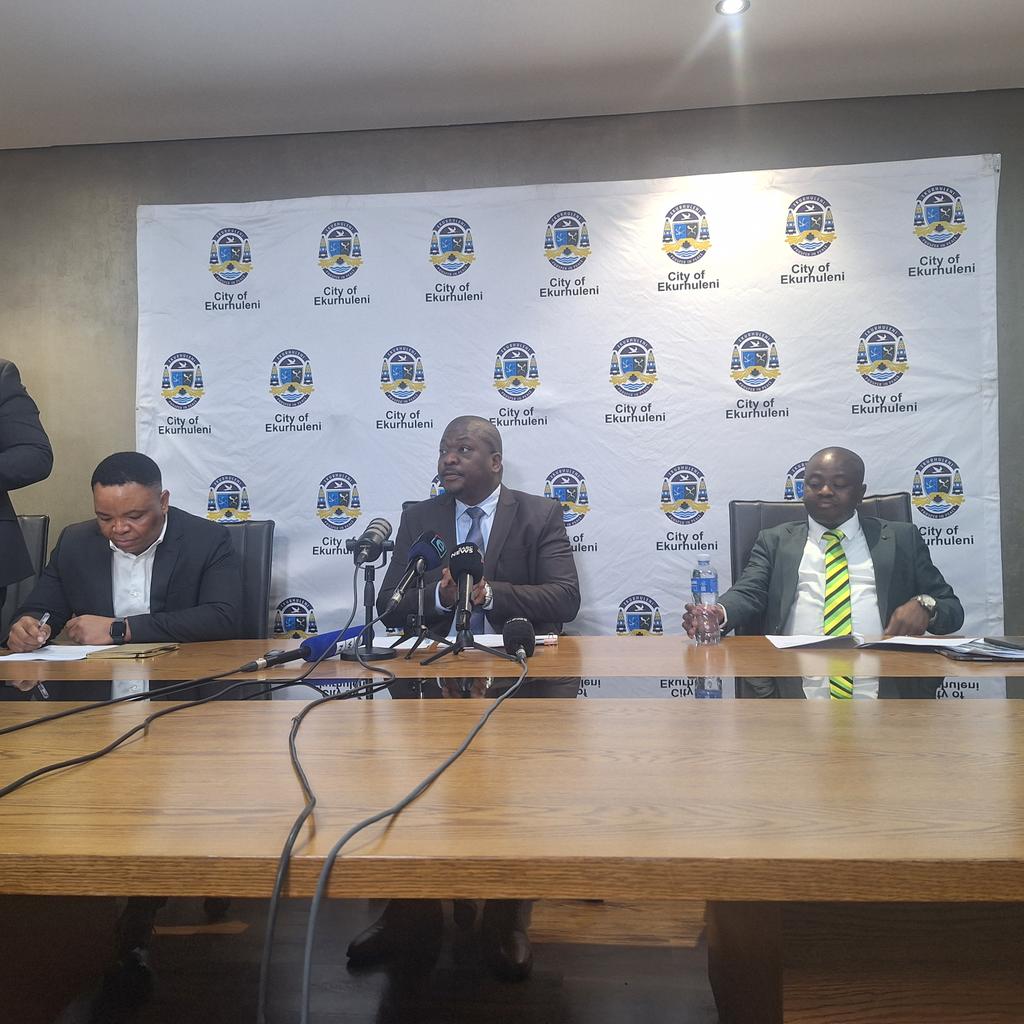
Speaking at a media briefing on Wednesday on the State of Governance in Ekurhuleni, Xhakaza outlined the city’s recovery from a R2 billion revenue shortfall and assessed the impact of recent political developments on stability and service delivery.
He provided a comprehensive overview of governance, financial recovery, political stability, and service delivery achievements, underscoring a period of renewed focus and tangible progress.
“The state of governance in Ekurhuleni is stable, and our progress is undeniable. We are building a city that is resilient, responsive, and reliable,” said Xhakaza.
“Our work is far from over, but we move forward with a renewed sense of energy, driven by our promise to restore service delivery with agility, innovation, and impact. This is our Road to Renewal in the City of Ekurhuleni.”
Following the recent ANC Regional Elective Conference, Xhakaza was elected Regional Chairperson, ushering in a unified leadership structure.
“With the political and administrative leadership now fully aligned, the risk of paralysis or the premature removal of a mayor has been firmly addressed,” said Xhakaza, framing stability as the foundation for delivering on the city’s priorities.
The mayor described this alignment as a historic milestone, resolving longstanding challenges arising from dual centers of power within the ANC that had previously hindered continuity in governance.
According to Xhakaza, the city now operates under a clear mandate, guided by the administration’s theme: “A Responsive City Working with Agility to Restore Service Delivery to the People.”
Xhakaza reported significant strides in strengthening the city’s financial position.
Through disciplined management, cash on hand nearly doubled, rising from 11 days to 21 days in the 2024/25 financial year.
The city’s bank balance improved to over R1.2 billion, up from R615 million, while investment balances surged to R672 million from R245 million.
These gains contributed to an upgraded credit rating, signaling renewed investor confidence in the municipality.
Xhakaza framed this turnaround as central to sustaining services and funding essential infrastructure.
“Every rand collected is maximised to fund the essential services our communities depend on,” he said.
Plans are underway for a revenue enhancement tender to further secure the city’s financial future.
A major financial challenge confronting Ekurhuleni has been a historical R2.1 billion shortfall in energy revenue.
The deficit emerged from inaccuracies in meter reading following the ICT Department’s abrupt takeover of the function.
Xhakaza detailed a three-pronged recovery strategy: integrity, accountability, and collection.
Automated meter reading accuracy has improved dramatically to 97%, up from 84%, restoring public confidence in billing fairness.
Nearly R1.4 billion has been billed, with over R365 million collected to date, and the city is actively pursuing the remaining R1 billion in billed but uncollected revenue.
Consequence management measures, including the suspension of the former Chief Information Officer and an ongoing disciplinary hearing, were also highlighted.
Beyond financial management, Xhakaza emphasized tangible improvements in service delivery.
In the Energy Department, 3,287 new household connections were provided, while 37 high-mast and 214 streetlights were installed to enhance safety.
Road infrastructure also received a boost, with 20 km of roads in Kempton Park CBD, 3.9 km of Pretoria Road in Benoni, and Nala Street in Duduza rehabilitated.
The first phase of the Bus Rapid Transit (BRT) system is now 90% complete, linking Tembisa to Rhodesfield, OR Tambo International Airport, and Isando.
The Ekurhuleni Metropolitan Police Department intensified community safety operations, exceeding its target of hotspot operations and expanding its vehicle fleet.
In Water and Sanitation, six reservoirs and eight pump stations are under construction, while sewer lines are being upgraded and unmetered stands addressed.
Waste collection has been extended to 209,000 households in informal settlements, with all landfill sites compliant and operational.
Parks, cemeteries, and environmental initiatives are being maintained through EPWP projects, and human settlements efforts delivered 167 housing units and serviced 455 stands.
A deliberate increase of R400 million in the repairs and maintenance budget, bringing the total to R3.1 billion, has targeted critical infrastructure.
Investments include R1.3 billion in energy repairs, R814 million for roads, R449 million for water and sanitation, and strategic upgrades to community services and public spaces.
A new Sanitation Services Sustainability Model is being implemented to reduce reliance on contracted services in informal settlements.
INSIDE METROS