

By Thapelo Molefe
The Western Cape government says Cape Town continues to attract record levels of investment, with billions of rands flowing into property, infrastructure and new industries, while pledging that growth must also reach township economies.
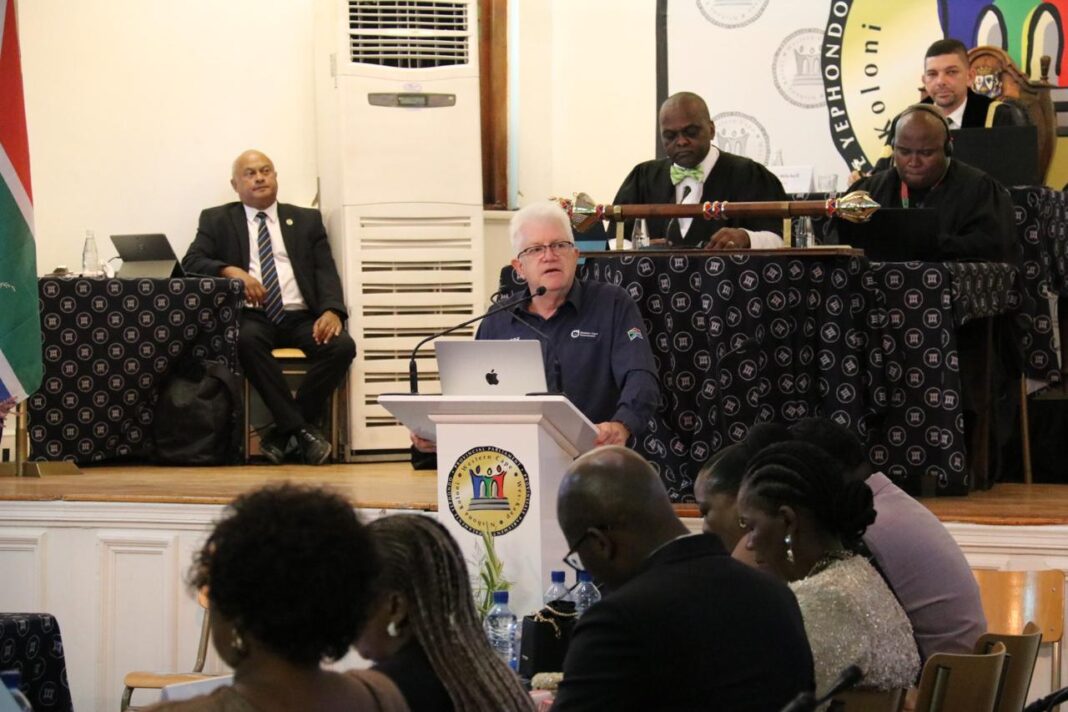
Delivering his 2026 State of the Province Address on Wednesday night, Premier Alan Winde said the province is seeing “massive investment in our cities and towns,” pointing to more than R9 billion invested in Cape Town’s central business district property market last year alone. A further R24 billion mixed-use development is planned for Granger Bay.
“It’s not only investments that are growing, but our exports too,” Winde said.
“We are the jobs province. People move here for better service delivery and for economic opportunity.”
ALSO READ: By-elections: IFP secures Nongoma ward from NFP as ANC and DA hold strongholds
According to figures presented in the speech, the value of building plans passed in the Western Cape reached nearly R35 billion last year, the highest in the country. Gauteng followed at R28.2 billion.
Winde said the construction sector alone created more than 57,000 jobs in 2025, describing it as “a powerful indicator of the confidence in our economy.”
Following the province’s inaugural investment summit last year, five major projects are now nearing financial close. These include R600 million in green hydrogen, R1.8 billion in manufacturing, R105 million in technology, R250 million in electric vehicles and R400 million in solar energy.
“These projects will create thousands more jobs for our residents,” Winde said. “That is thousands more families with food on their table and a roof over their heads.”
Cape Town International Airport recorded more than 11 million two-way passengers in 2025, its busiest year on record, with more than 200 international flights landing weekly.
ALSO READ: New local government funding model due by October as municipalities receive R178bn
Winde said tourism remains a key economic driver, noting that during December 2025, Cape Town, Stellenbosch and Plettenberg Bay accounted for 67% of all international visitor payments nationally, with R500 million flowing into local businesses.
But while much of the headline investment is concentrated in the CBD and major economic nodes, the provincial government says it is also targeting township and small business growth.
Since 2022, the number of small businesses in the Western Cape has grown by more than 143,000, representing a 55% increase compared to 18% nationally.
“The Western Cape Government supports this growth by cutting red tape and providing tailored business support,” Winde said.
He added that nearly R5 billion of government procurement in the past year went to women-owned businesses, accounting for 34% of total procurement, while close to R4 billion flowed to small and medium enterprises.
“These numbers are an indication of a focused government at work, supporting growth and jobs,” he said.
Initiatives such as the SME Accelerator Support Programme, partnerships with the Johannesburg Stock Exchange and tech-focused training sessions are aimed at preparing small businesses for investment readiness.
The province has also expanded free public Wi-Fi to 1,600 sites, reaching nearly six million subscribers. Winde said this allows entrepreneurs and job seekers in townships and rural areas to access digital markets and services.
Infrastructure upgrades are also being framed as economic enablers. The reopening of Kapteinsklip train station in Mitchells Plain is expected to improve connectivity between residential areas and economic hubs.
“Functional public transport supports growth and jobs,” Winde said. “For many jobseekers, the cost of getting to an interview can be the difference between finding work or staying unemployed.”
Blended finance models, which combine public and private funding, are being used to accelerate mixed-income housing developments such as Conradie Park and planned social housing closer to Cape Town’s city centre. The government argues that spatial integration is necessary to ensure that economic growth is not limited to established commercial districts.
“Growth and jobs are the cornerstone of our vision,” Winde said.
“Nothing fixes a life like a job, nothing builds dignity like a job, and nothing puts food on the table like a job.”