

By Sihle Mavuso
uMngeni-uThukela Water – the bulk water supplier to eThekwini Municipality — has denied that sabotage linked to the so-called water tanker mafia caused the Nagle Dam valve failure, which left thousands of residents in over 60 suburbs and townships without water for almost three days.
The valve failure resulted in a reduction of 150 megalitres of water per day that is usually supplied to the metro for treatment at the Durban Heights Water Works.
ALSO READ: SAPS, SANDF unpack joint crackdown on organised crime
Responding to claims of sabotage, uMngeni-uThukela Water spokesperson Siyabonga Maphumulo said the board had no official information suggesting foul play.
“As uMngeni-uThukela Water, we are not aware of any sabotage claims. What we are aware of is that the valve broke during a routine maintenance operation,” Maphumulo said.
He did not specify whether the damage was caused by uMngeni-uThukela Water staff or by a private contractor working on the system.
Concerns about “water mafias” in eThekwini and KwaZulu-Natal are not new.
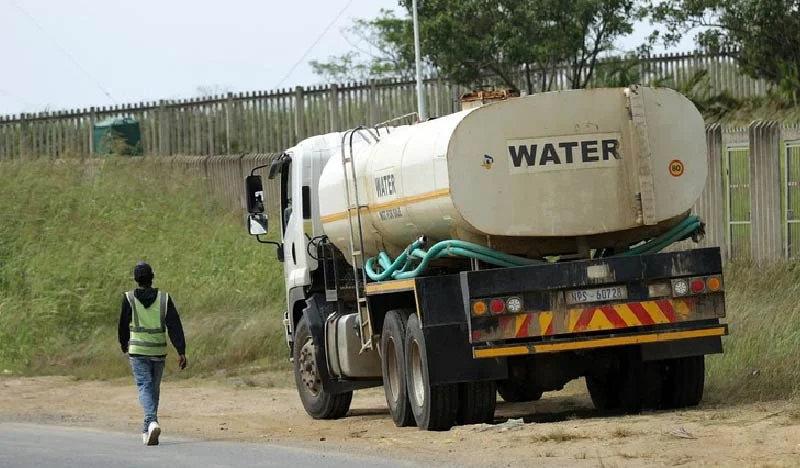
In a July 2025 statement, Deputy Water and Sanitation Minister David Mahlobo said criminal syndicates were deliberately disrupting water networks, damaging “pump stations, pipelines and valves” and then profiting by selling tanker water at inflated prices. Mahlobo called it economic sabotage.
In a written parliamentary reply in 2023, the water ministry similarly acknowledged allegations that infrastructure is at times vandalised to prolong business opportunities through tankers.
ALSO READ: Shibiri maintains no wrongdoing, despite evidence of Matlala relationship
The Nagle Dam valve failure, first reported on 11 March, disrupted the supply of raw water to the Durban Heights Water Treatment Works, which supplies treated water to a large number of areas across eThekwini’s northern, southern and western systems.
The board’s denial comes after claims circulated within political and community circles in the city that the valve may have been damaged by people linked to the water tanker mafia.
Recently, ANC councillor Luthando Jali was recorded while addressing a community meeting in Ntshongweni, where he said that when there is a water crisis in the area, his hands are tied because the system is sometimes “deliberately sabotaged” in order to bring in tankers.
Jali said he received death threats after the video was widely circulated on social media,. He told Inside Politics he had gone into hiding because he feared he could be killed for making the statements.
The water crisis forced eThekwini Municipality and uMngeni-uThukela Water to scramble to contain the fallout as homes, businesses and tourism sites were hit by shortages.
In a statement released on Sunday, the municipality said repairs had been completed.
“The bulk water supplier, uMngeni-uThukela Water, which is responsible for the repair work, has confirmed that the damaged valves have now been successfully repaired,” it said.
ALSO READ: Lekota remembered: Courage, sacrifice, and the promise of freedom
“This marks a critical step toward restoring normal operations within the eThekwini water supply system. As a result, the Durban Heights Water Treatment Works will be able to operate at full treatment capacity from tomorrow, 16 March 2026.”
But, added the municipality, while treatment capacity had been restored, “the full reticulation of the system will take time”.
“The stabilisation and replenishment of reservoirs and pipelines across the network is expected to take up to two weeks.”
To manage the recovery, the city said it had introduced temporary rationing.
“Under the temporary rationing plan currently being implemented across affected systems and reservoirs, some consumers will receive water during the morning only, while others will receive water during both the morning and afternoon until the system stabilises.”
Under the ANC-led eThekwini Municipality, unplanned water outages have become a recurring feature of daily life, with residents telling the city in its draft 2025/26 IDP review that they “routinely face water outages” and sometimes go for days without.
President Cyril Ramaphosa has said the Presidency will continue targeted support at the metro through the Presidential eThekwini Working Group to improve basic services.
At a stakeholder meeting earlier this month, he said non-revenue water in the city stood at 55%, “far above acceptable benchmarks”.