
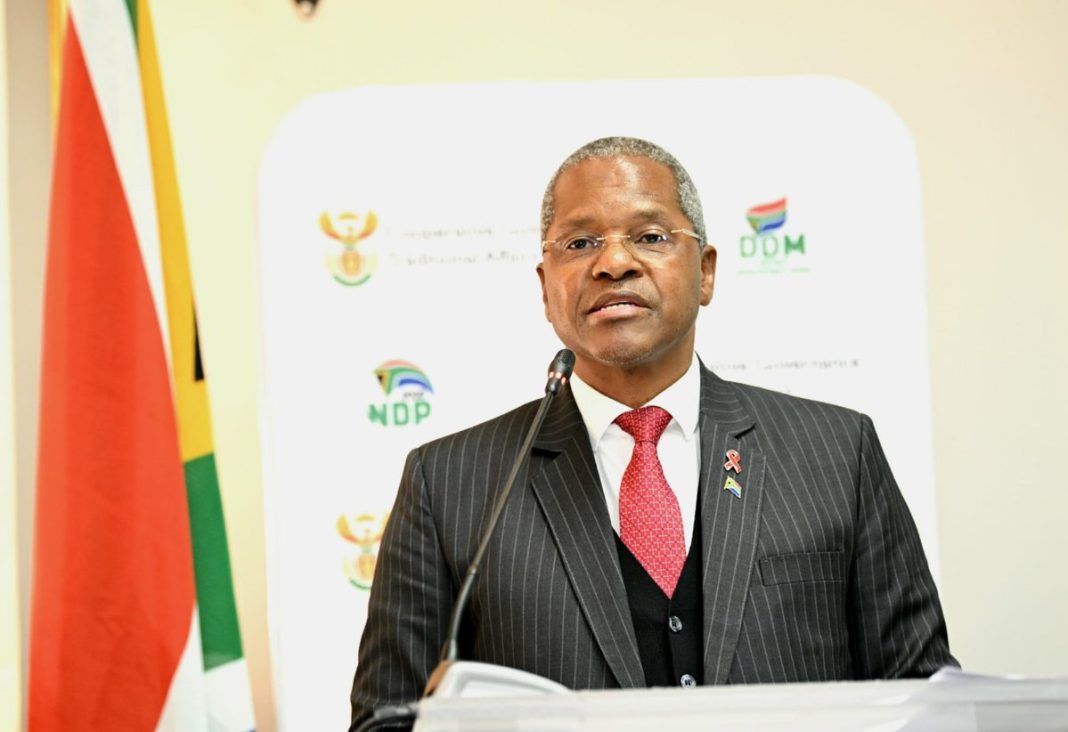

By Thapelo Molefe
Cooperative Governance and Traditional Affairs (Cogta) Minister Velenkosini Hlabisa has warned that South Africa’s economic stability is at risk if struggling metropolitan municipalities are not urgently fixed, while announcing plans to force government departments to settle outstanding debts owed to cities.
Speaking at the Ministerial Engagement in Boksburg on Friday, Hlabisa said the country’s eight metros, which house 62% of the population and generate more than two thirds of GDP, are facing deepening governance and financial crises that threaten both service delivery and economic growth.
“If these eight metropolitan municipalities are not fully functional or are in a state of collapse, the country will soon collapse,” he said.
The minister said many metros are grappling with political instability, weak governance, declining revenue and mounting debt to bulk service providers such as Eskom and water boards.
At the same time, municipalities are owed significant sums by government departments, worsening already strained finances.
In a key intervention, Hlabisa confirmed that National Treasury is finalising verified data on outstanding debts owed to municipalities by national and provincial departments.
The matter is expected to be taken to Cabinet by the end of April.
He said this process would pave the way for stronger enforcement measures.
“National Treasury would now be equally able to withhold funds from departments if they don’t pay their accounts or enter into payment arrangements with municipalities,” he said.
The minister said unpaid government bills, combined with declining municipal revenue and low collection rates, are undermining the financial sustainability of metros and affecting their ability to deliver basic services.
Hlabisa linked the financial instability of metros to broader governance failures, including poor decision making, lack of accountability and weak revenue collection systems.
He said these challenges are interconnected and have fuelled rising community frustration and service delivery protests.
“The protests we see are a direct result of this systemic failure,” he said, adding that declining public trust in municipalities underscores the urgency of reform.
The minister called for stronger intergovernmental coordination and partnerships as a central pillar of recovery, warning that fragmented planning and siloed operations have undermined effective service delivery.
He said the District Development Model, which promotes a “One Plan, One Budget” approach across national, provincial and local government, would be reinforced through new regulations set to be finalised in April.
These regulations, agreed upon by all metros, are expected to close existing gaps in coordination and planning.
Hlabisa also highlighted the role of private sector partnerships in addressing infrastructure backlogs and improving urban capacity, urging metros to actively mobilise external investment and technical expertise.
“Our metros are better placed to attract critical skills in finance and engineering, but they must also leverage private sector support to drive development,” he said.
The minister further confirmed that government is reviewing the local government funding model in collaboration with National Treasury and the South African Local Government Association, with discussions expected to conclude in April.
On service delivery, Hlabisa said metros must use existing funding instruments more effectively, particularly the Metro Trading Services grant, to improve billing systems, strengthen cash flow and increase investment in maintenance and infrastructure.
He also pointed to ageing infrastructure and rapid urbanisation as major pressures on cities, warning that without decisive intervention, these factors will continue to erode service delivery capacity.
Looking ahead, he urged municipalities to strengthen governance and maintain stability as the country prepares for local government elections expected later this year or in early 2027.
He confirmed that voter registration weekend has been set for 20 and 21 June.
Hlabisa said government is also reviewing the local government funding model and the 1998 White Paper on Local Government as part of broader reforms aimed at improving municipal performance.
Despite the challenges, the minister said the current engagement with metro leaders should serve as a platform to develop practical solutions and share best practices.
“We are not only here to acknowledge the problems, but to forge pathways towards tangible solutions,” he said.
Hlabisa concluded by emphasising that cooperation across all spheres of government will be critical to reversing the decline of metropolitan municipalities and safeguarding the country’s economic future.
“We are three spheres of government, but one country,” he said.
“By working together, we can restore public trust and improve the quality of life for all South Africans.”
INSIDE METROS