

By Lebone Rodah Mosima
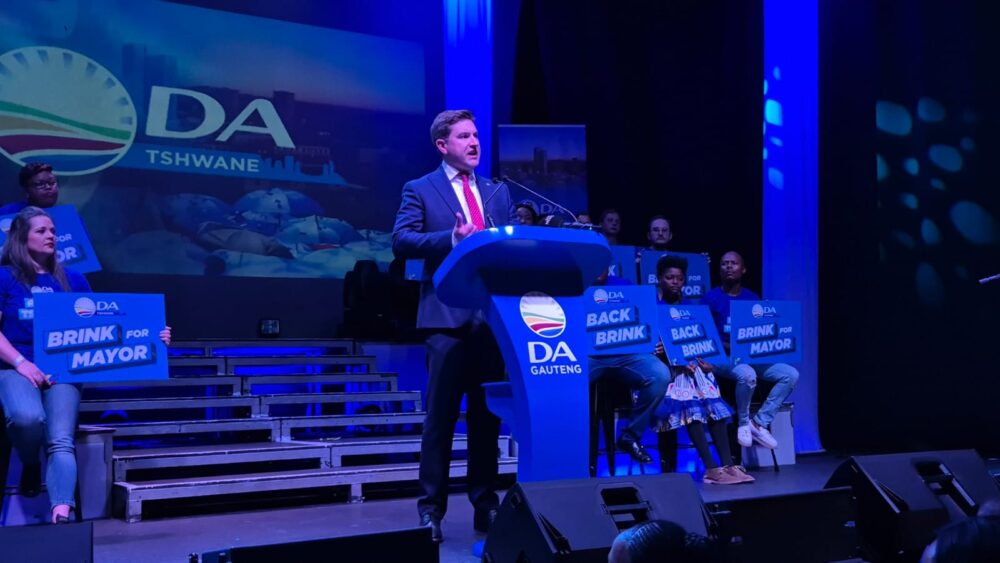
Democratic Alliance (DA) mayoral candidate for Tshwane, Cilliers Brink, said on Saturday that South Africa’s water crisis is not caused by a lack of rainfall, but by corruption and the misappropriation of funds.
Speaking at a Human Rights Day rally organised by the DA in Hammanskraal, Pretoria, on Saturday, Brink said the crisis reflects governance failures rather than natural conditions.
He criticised the Klipdrift package plant, intended to resolve the long-standing Hammanskraal water crisis and supply clean water, and blamed the ANC-led government for its failure.
“This plant was built for hundreds of millions of rands,” Brink said.
“But you know what? They took us out because the ANC makes profit from these trucks here.”
Brink further accused the government of diverting funds to the Madlanga Commission instead of completing the plant, and of spending R777 million on water tankers.
He also alleged that Tshwane Deputy Mayor Eugene Modise benefits from the water tanker system despite being investigated by the Special Investigating Unit (SIU).
“That is the reality of what we have under the ANC,” he said.
“But enough is enough. Let us stand together and bring victory and water to the taps of the people of Hammanskraal and the rest of Gauteng.”
GOOD Party Secretary-General Brett Herron said the struggle to translate constitutional rights into improved lived experiences for the majority persists.
“With local government elections on the horizon, populists, sellers of identity politics, and those who don’t believe in non-racial justice are licking their lips,” Herron said.
He noted that more than 350 years of socially structured inequality have denied the basic humanity of the majority, driven by factors such as government inefficiency and resistance to redistributive justice.
“The environments in which millions of people live today are disgraceful,” Herron said.
“Millions of people don’t have jobs, don’t have enough to eat, don’t have a decent roof over their heads … live in a sea of need, crime, and misogyny.”
Herron warned that slow progress in normalising an unequal society continues to fuel populism and threatens the sustainability of constitutional democracy.
“Most thinking South Africans know better: They know you can’t just wish away the impacts of 350 years of history, that the longer it takes to clean wounds, the greater the danger of infection … that continued failure to turn paper rights into better lives for the majority of South Africans is our greatest threat,” he said.
He urged those in power to accelerate progress or step aside for leaders with alternative visions for the Constitution, humanity and human rights.
South Africa commemorates the victims of the Sharpeville Massacre, where lives were lost in the fight for equal rights against apartheid oppression.
Also speaking at the Human Rights Day event, City of Johannesburg MMC for Health and Social Development Ennie Makhafola said her department has made notable strides in upholding citizens’ fundamental rights.
“I am proud of the significant progress our department has made in advancing these rights, ensuring that dignity, equality, and freedom are tangible realities for our people,” Makhafola said.
She said the department has provided free basic services — including water, sanitation and other essentials — to more than 100,000 indigent individuals.
Makhafola added that the department has also addressed homelessness through sustainable interventions, including family reunification programmes.
“Our programmes, including dedicated family reunification initiatives, have reunited individuals living on the streets with their families, restoring not just shelter but also their sense of belonging,” she said.
Other interventions include substance abuse rehabilitation services, improved access to primary health care, and the establishment of one of the largest food bank distribution networks in Johannesburg, reaching over 200,000 households.
She said psycho-social support services and skills development programmes further promote mental well-being and economic participation.
“This is the realization of the right to work, the right to education, and the right to participate in the economy,” Makhafola said.
Meanwhile, Economic Freedom Fighters (EFF) leader Julius Malema told supporters during a voter registration campaign in Johannesburg that President Cyril Ramaphosa had agreed with the party’s call to operate clinics on a 24-hour basis.
Malema praised Makhafola for championing the initiative in Johannesburg.
“The 2026 EFF local elections banner has been unveiled. Battle lines have been drawn. We call upon all volunteers of the EFF to go to the ground and sharpen their weapons, register the youth in numbers, and leave no stone unturned,” Malema said.
“The EFF shall be the last man standing on the battlefield because it is victory or death.”
INSIDE METROS