

By Johnathan Paoli
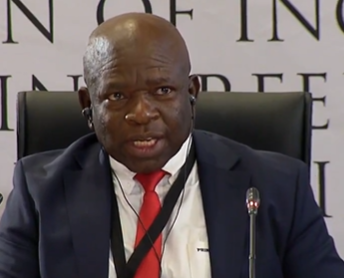
Suspended Director of Assets at the Tshwane Metro Police Department, Tshukudu Malatji, has come under fire at the Madlanga Commission of Inquiry for conflicting testimony, as the commission continues to probe a controversial multi-million rand security tender.
Appearing on Thursday, Malatji initially maintained that no concerns about irregularities were ever brought to his attention during the Bid Evaluation Committee (BEC) process.
ALSO READ: Malema expands on his relationship with Ze Nxumalo
“I can assure the Commissioner and this Commission that from the beginning to the end, we never had a situation where there was a complaint to the effect that documents were tampered with, and so forth and so on. We just waited. We waited for a very long time,” Malatji said.
However his claims drew sustained skepticism from commission chair Mbuyiseli Madlanga and other commissioners, who questioned how a senior official so deeply involved in the tender could claim ignorance of key developments, including litigation and the alleged disappearance of documents.
The contested tender (TMPD 02-2016/2017) concerned the appointment of 22 private security companies to provide guarding and protection services for hundreds of municipal assets, infrastructure, personnel and facilities, amid longstanding capacity constraints.
Malatji confirmed that he had played a central role in the tender, assisting with drafting specifications, serving as a BEC member, preparing reports for the Bid Adjudication Committee, and acting as the designated contact person.
ALSO READ: Kubayi: Whistleblower bill proposes witness protection, cash rewards
Madlanga challenged Malatji’s claim of “not knowing”, describing it as “very, very strange” and “difficult to accept”, given his level of involvement.
The chair said that it was implausible that he would not have asked questions about why the tender stalled or ended up in litigation.
“I find it very difficult to accept that you remained ignorant of the issues that are delaying your tender. When you had a direct interest in this tender being finalized and security companies being appointed, you must have known. You must have asked the questions,” Madlanga said.
Malatji said that institutional hierarchies limited his access to information once the BEC had completed its work.
While he denied knowledge of missing documents, Malatji later admitted that the BEC had raised serious concerns about the security of tender records stored at supply chain management offices.
According to his testimony, the facility lacked access control, surveillance cameras were not functioning, and officials could freely enter and exit.
These vulnerabilities prompted the relocation of tender documents to the Tshwane Leadership Academy, also known as Premos, for safekeeping.
Malatji said this was a precautionary step rather than a response to confirmed irregularities.
However, commissioners pointed out that his own description of the environment suggested clear risks of interference.
Malatji conceded that the use of physical tender files made the system susceptible to manipulation.
“It could be a number of factors, which might include the fact that for as long as tenders are submitted on files like this, and to these files, officials have access to each and every file. I’m talking here specifically within the supply chain management environment. Such incidents could take place, but now, thinking of how these kinds of things can be prevented going forward,” he said.
ALSO READ: Kind, caring’ Judge Taswell Papier mourned by legal fraternity
As questioning intensified, the focus shifted from procurement irregularities to contract management failures after the tender was eventually implemented following a court order in 2021.
Malatji said that senior management never formally briefed him on the reasons for the litigation or the eventual cancellation of the tender; insisiting that he only became aware that the tender had gone to court “like any member of the public” and never sought further details.
“I heard that the tender is in court, but as to reasons why it has been taken to court, I never became aware of those reasons,” he said.
Under sustained probing, Malatji acknowledged that oversight weaknesses in TMPD’s monitoring of private security companies created the possibility that the metro may have paid for services that were not rendered.
Evidence before the commission indicated that contractual obligations required site inspections at least twice a month, but these were not consistently carried out across more than 500 locations due to capacity constraints.
Pressed on whether invoices could have been processed without proper verification of service delivery, Malatji conceded that this was a real risk.
Malatji said invoice verification focused primarily on matching billing to contractual allocations, rather than confirming whether guards were physically present at sites.
According to Malatji, limited staffing and resources meant that inspections could not be conducted as frequently as required, weakening the city’s ability to detect discrepancies.
Throughout the session, Madlanga repeatedly cautioned Malatji against being defensive, stressing that the commission’s role was to uncover systemic failures rather than assign personal blame without evidence.
The commission continues.
INSIDE POLITICS