Thapelo Molefe
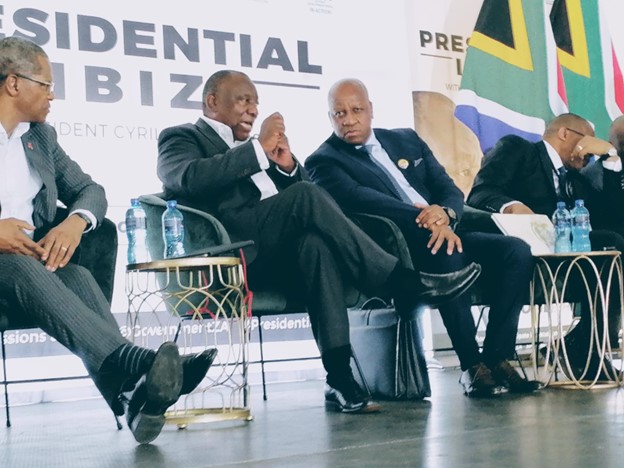
Ethekwini residents gathered at the Umnini Sports Field in Umgababa, south of Durban, to interact with President Cyril Ramaphosa, his cabinet and KwaZulu-Natal provincial government officials to raise their concerns in their metro during the Presidential District Development Imbizo.
Unemployment, crime, housing, the rising cost of living and education were some of the main issues raised by residents at the imbizo.
The embattled eThekwini Municipality is one of the metros the president has been closely monitoring as it tackles various service delivery challenges.
A concerned resident from Umgababa, Mthobisi Shila, told the gathering that there was an urgent need for industrialization to create jobs.
“The problem is that people [in Ethekwini] are unemployed, that is why the crime rate in South Africa is so high. We need to industrialize for job creation,” said Shila.
Shila also called for clarity on the land expropriation program without compensation, highlighting the necessity of land for industrialization.
Another resident known only as Nhlakanipho, raised concerns around electricity crisis in the region, including the failure of a previously handed-over dam to supply water to the community.
On road maintenance, Nhlakanipho said poorly maintained roads were reported, hindering access to essential services.
He also noted the lack of network coverage that prevents children from being contacted for school and job opportunities, adding that the community’s large size and distant hospital location result in fatalities during transportation.
Busisiwe Bhaqwa raise the issue of crime and criticized the inadequate policing in six wards in the area, comparing the local police station to a “spaza shop.”
Bhaqwa emphasized the community’s need for protection.
“One to three police officers work on weekends…sometimes the gates are closed because there are no police. We protect ourselves because there is no one to protect us,” she said.
Nokulunga Siqubu expressed frustration over the 10-year unemployment of graduates, inadequate teacher staffing, and insufficient funding.
She questioned the value of the R350 unemployment grant and called for an increase to R1300.
Senzo Gumede and Gabisile Nxumalo highlighted the neglect of disabled individuals, citing inadequate job opportunities, inaccessible public transport, and insufficient grant funding.
Sanelisiwe Msomi inquired about the status of 1000 promised RDP houses for Ward 182, initially scheduled to begin construction in June.
KZN premier Thamsanqa Ntuli responded to concerns raised by residents during the presidential mbizo, focusing on crime, unemployment, and housing.
He emphasized the province’s role in combating crime, highlighting the department of community safety and liaison’s partnership with national and eThekwini authorities.
He praised the police for raising their standards, resulting in the arrest or neutralization of eight criminals who attempted to fire shots at officers.
To address unemployment, Ntuli announced a R100 billion fund to assist young entrepreneurs, with applications extended until the end of November.
Additionally, Ntuli said a R200 billion fund was launched for women entrepreneurs.
The KZN Premier also promised to investigate housing concerns, instructing the MEC to provide a progress report.
“A provincial imbizo will be held to report on progress and future plans,” he said.
Ramaphosa echoed the Premier’s sentiments, highlighting the unity between national and provincial governments in addressing challenges.
“As I end, I think we have held a fairly productive imbizo session. Today has been a clear demonstration of how our Government of National Unity is also working. I have Ministers from our various political parties that are part of the GNU,” said Ramaphosa.
“I would like to thank them all and I want all the parties in the GNU to see the value of izimbizo. They are important because they enable us to interact with our people and hear their views, and answer their questions and at the same time, follow up on their issues that they have raised.”
At the event, tensions flared between the South African Democratic Teachers Union (Sadtu) and Basic Education Minister Siviwe Gwarube, as Sadtu members, led by KwaZulu-Natal provincial secretary Nomarashiya Caluza, criticised Gwarube for failing to address school funding shortages.
The union demanded that monies owed to schools for norms and standards be paid. They also wanted security to be beefed up in schools around the province.
During the fracas, Ramaphosa had to intervened and urged residents to lower their placards, assuring them he had noted their messages.
When she eventually spoke, Gwarube assured protesters and everyone that education was a huge priority for government, but raised said there were budget constraints.
Gwarube pledged to work with the MEC of Education in KZN and the Minister of Finance Enoch Godongwana to allocate sufficient funds for teachers, scholar transport, and school meals.
Gwarube also addressed dropout rates, emphasizing the importance of skills training for non-academically inclined learners.
She said the implementation of the Basic Education Laws Amendment Act was underway, despite ongoing discussions on two clauses.
“It was good to address the issues facing the education department in the province. The solutions we are working on with Treasury will bring about relief,” she said.
Earlier on Thursday, Gwarube visited the construction of the Maritime School in eThekwini that is going to provide skills for young people to access jobs in the ocean economy.
The school features 24 standard classrooms with smart interactive boards instead of traditional blackboards, 10 specialist laboratories equipped with smart screen televisions and foam cupboards with extraction fans for storing hazardous chemicals, and an ocean simulation room.
“This institution is part of the Department’s strategy to establish focus schools that develop specialised skills in support of South Africa’s maritime and blue oceans economy.”
“Here we have a maritime school where learners will be coming to specialise particularly in maritime studies. It is particularly important because the province is looking at the ocean economy and how we can get local learners to come here to fit into the world of work,” she told reporters.
INSIDE METROS