By Thapelo Molefe
President Cyril Ramaphosa says South Africa is intensifying large-scale water infrastructure projects to address mounting supply pressures and secure sustainable access for households, communities, and industries for decades to come.
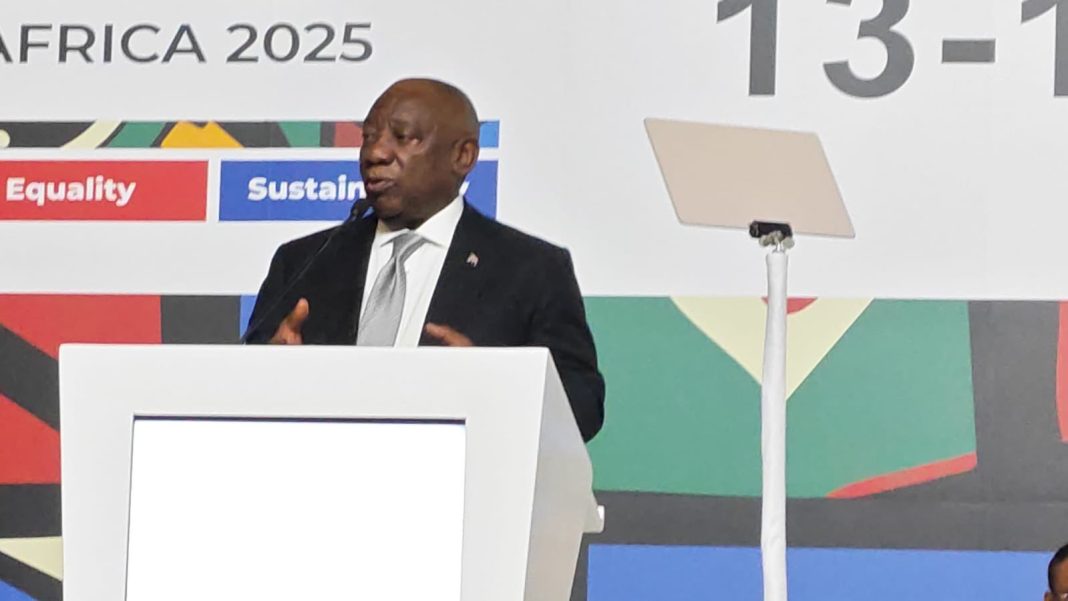
Speaking at the Africa Water Investment Summit in Cape Town on Wednesday, Ramaphosa cited the recent launch of the second phase of the Zuikerbosch Water Purification Plant in Gauteng as proof that the country can deliver “mega project investments” that directly meet demand.
“This flagship project is a demonstration of our government’s commitment to infrastructure investment, economic upliftment and ensuring sustainable water supply for future generations,” he said.
The System 5A plant at the Zuikerbosch Water Treatment Works in Vereeniging—part of Rand Water’s System 5 initiative—is the largest of its kind in Africa.
Construction, costing about R3.9 billion, began in 2019 and was rolled out in stages.
Phase 1, which came online in late 2022, added 150 million litres per day to the network.
The plant’s full capacity of 600 million litres per day is now expected to benefit roughly 2.4 million people across Gauteng and parts of North West, Mpumalanga and the Free State.
This expanded capacity strengthens Rand Water’s efforts to safeguard supply for South Africa’s economic heartland while building resilience against climate change and population growth.
“Water is not just a basic human need. It is the lifeblood of any thriving society,” Ramaphosa said.
“Our people expect clean water when they turn on the tap. Clean water is not a luxury. It is a right.”
At the summit, he linked water investment to economic growth, describing it as “not just a means of survival but a driver of economic transformation, innovation and peace.”
South Africa’s strategy, he said, is to shift water from a crisis sector into an “opportunity sector” by building capacity, improving governance, and unlocking new funding streams.
Ramaphosa stressed that water security is a core pillar of the government’s infrastructure agenda.
“We are bringing Africa and international partners together and calling on investors to heed the call to invest in water,” he said, adding that sustainable water management must be prioritised alongside energy and transport.
While much of his address touched on global water challenges, he underscored the urgency of domestic action.
This includes investing in purification, storage, and distribution systems, and improving maintenance to reduce losses from leaks and inefficiencies.
“Let us build a world where every drop counts and every community thrives. Let us build a world where water is recognised as a human right and not weaponised against women, children and communities,” he urged.
“Let the work begin. Let us leave no one behind.”
Rand Water’s flagship initiative draws raw water from the Vaal River via the Integrated Vaal River System, using a multi-stage purification process that includes coagulation, rapid sand filtration, pH adjustment, and chlorination.
The launch comes amid a severe water crisis in Gauteng, where municipalities such as Johannesburg, Tshwane, Ekurhuleni and Sedibeng have faced repeated outages, low pressure and service disruptions.
In February, a power failure at the Vereeniging purification plant caused rolling outages, leaving hundreds of thousands without running water and driving reservoir levels dangerously low.
Gauteng’s water network is strained by aging pipes, rampant leaks, and chronic underinvestment.
Nearly half of treated water is lost through leaks or inefficiencies.
Some municipalities, including Emfuleni and Metsimaholo, carry crippling debt to Rand Water and Eskom, further undermining service delivery.
In areas like Hammanskraal, residents have protested after months of unreliable supply, with some forced to consume untreated or contaminated water, raising serious health risks.
INSIDE METROS