By Akani Nkuna
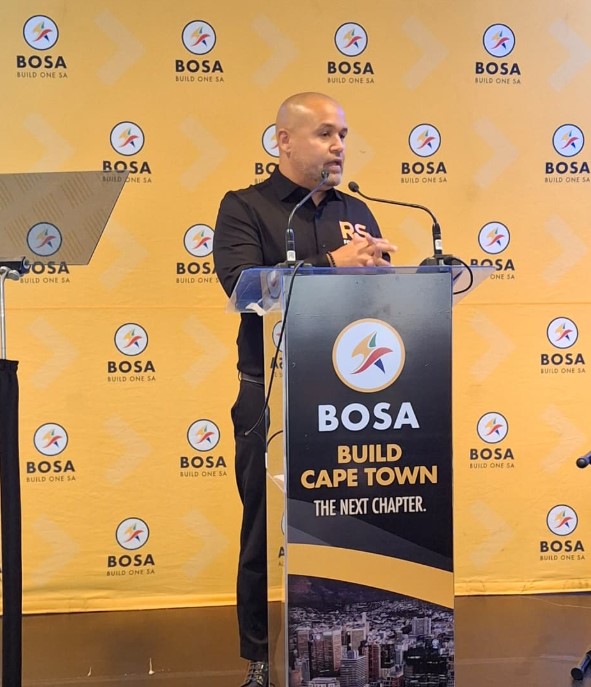
Build One South Africa on Saturday named its national spokesperson, Roger Solomons, as its mayoral candidate for Cape Town, entering a widening race to challenge the Democratic Alliance’s control of the city in the November local government elections.
Solomons accepted the nomination at an event at the Iziko South African Museum in Cape Town, where he said the 2026 local government elections would be a contest about affordability, inclusion and whether the city’s economic gains were reaching working-class communities.
“The next chapter for Cape Town must be a deliberate shift, from stability to shared progress, where growth, safety and opportunity are experienced across the whole city. Administrative competence and relative stability have been achieved, and that must be acknowledged,” he said.
“But competence alone does not create justice, and stability alone does not create inclusion. I am not stepping up to lead Cape Town because I believe the city is broken. I am stepping up, because I believe it is unfinished.”
The country is scheduled to hold local government elections on 4 November. The DA has already announced incumbent mayor Geordin Hill-Lewis as its Cape Town candidate, while ActionSA has named Dereleen James and GOOD and Rise Mzansi have backed Brett Herron.
The DA retained Cape Town in the 2021 municipal elections with 58.2% of the vote and 135 seats, giving it an outright majority in South Africa’s only DA-run metro. Opposition parties have increasingly sought to campaign on inequality, housing, transport and the high cost of living in the city.
Solomons said affordability would be central to BOSA’s campaign, adding that municipal decisions should be tested against their impact on residents rather than only their cost to the city.
“Cape Town should be the easiest city in South Africa in which to build a life. Not the most expensive city in which to survive,” Solomons said.
“A city where affordability is the organising principle of governance. Where decisions are not first asked: what does this cost the City? But rather: what does this cost the resident? Because those are not always the same question. And too often, they have been answered in reverse.”
Solomons said a BOSA-led administration would seek to reduce barriers for small businesses, including by removing municipal business licence fees for qualifying small and micro-enterprises in their first year of operation.
He also promised greater investment in township economies and informal enterprises, improved digital inclusion, and more affordable and reliable public transport linking communities to economic hubs.
On housing, Solomons said the city needed to make better use of public land and accelerate affordable housing delivery.
“I will treat housing as one of the defining affordability pressures of this city. We will commit to doubling the current rate and delivering at least 10,000 affordable housing opportunities per year. We will conduct a full audit of all municipal land within 90 days of taking office. And we will establish a City Land Housing Programme that ensures public land is used for public need,” Solomons said.
He said Cape Town’s public safety problems, inequality and housing pressures required leadership that involved residents more directly in decision-making.
Solomons also spoke about his Christian upbringing, saying it had shaped his view of public service and responsible leadership.
BOSA leader Mmusi Maimane said South African politics had become too focused on division and “victimhood” rather than collaboration, and argued that Cape Town should not remain under single-party dominance.
He said BOSA was open to participating in coalition government after the 2026 elections, saying coalition politics could strengthen accountability if parties worked around shared priorities.
“People fear coalitions, and maybe they have reasons to do so. There is strength in coalitions because coalitions bring different ideas,” Maimane said.
INSIDE METROS