By Charmaine Ndlela
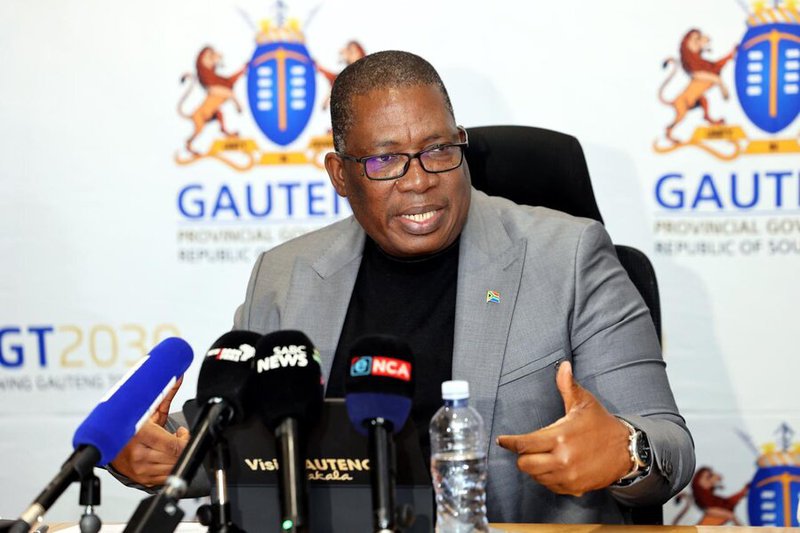
Gauteng Premier Panyaza Lesufi has vowed to tighten accountability across the provincial government after a forensic investigation into the controversial Kopanong Precinct project uncovered R558 million in irregular expenditure linked to leases for privately owned buildings.
The findings were among several governance issues highlighted by Lesufi during an update on key Gauteng Provincial Government programmes on Wednesday.
The province also revealed that 3,671 officials have submitted lifestyle audit forms, while 20 officials have been referred for further investigation.
Lesufi said the Kopanong forensic investigation had exposed serious weaknesses in the management of lease agreements involving nine provincial government departments.
The investigation found that there were no proper procurement or approved deviation processes, while contract management was weakened by automatic lease renewals and repeated month-to-month extensions.
It identified R558,079,624.71 in irregular expenditure.
“I have noted the findings of the report and will ensure that all its recommendations are implemented as a matter of priority,” Lesufi said.
The premier said the Department of Infrastructure Development would have to reassess its leasing strategy, particularly given delays in implementing the Kopanong Precinct Project.
The investigation followed concerns over the continued leasing of privately owned buildings while government-owned buildings remained vacant.
Lesufi said the province was committed to strengthening governance and ensuring that public money was properly managed.
“We remain committed to strengthening governance, improving accountability, and ensuring that public resources are managed efficiently and in the best interests of the people of Gauteng,” he said.
The Kopanong findings come as the provincial government intensifies lifestyle audits of officials working in functions considered vulnerable to financial misconduct.
The current phase focuses on Supply Chain Management and Finance officials across Gauteng government departments.
According to Lesufi, 3,671 officials have submitted lifestyle audit forms.
He has requested the Special Investigating Unit (SIU) to conduct comprehensive forensic investigations into the lifestyles of 20 officials from the two functions.
Fourteen officials from the Office of the Premier have been referred for further investigation, including eight rated as high risk and six as medium risk.
A further six officials from Gauteng CoGTA were referred, with two rated as high risk and four as medium risk.
Lesufi said the provincial government would wait for the outcome of the SIU investigations before taking appropriate action.
“Appropriate actions will be taken once the SIU has completed its comprehensive investigation,” he said.
The lifestyle audit process has also expanded to the Gauteng Department of Health, with the first audit focusing on Supply Chain Management and Finance officials at Tembisa Hospital.
The SIU has also been requested to conduct lifestyle audits on three newly appointed heads of department in Agriculture, Sport, Arts, Culture and Recreation, and Roads and Transport.
The State Security Agency is finalising the vetting and lifestyle audits of MECs responsible for e-Government, Environment, and Roads and Transport.
Lesufi said lifestyle audits of all CEOs and heads of departments had been completed.
The province also reported mixed audit outcomes for the 2025/26 financial year.
Five departments, including the Office of the Premier, Treasury, e-Government, CoGTA and Community Safety, sustained clean audit opinions with no findings.
Nine departments received unqualified opinions with findings.
The Department of Economic Development and the Department of Transport regressed from clean audit opinions to unqualified opinions, while the Department of Environment received an unqualified opinion.
The Department of Sport, Arts, Culture and Recreation improved from a qualified audit outcome in the previous year.
Lesufi said the mixed audit results demonstrated that while some departments were maintaining strong financial controls, others still needed to improve accountability.
The premier also outlined progress in implementing recommendations from investigations by the SIU, forensic investigators and the Public Protector.
At the Department of Agriculture and Rural Development, the SIU recommended disciplinary action against 10 current and former officials in connection with the Farmyard Project investigation.
The recommendations include criminal referrals where appropriate and lifestyle audits.
The Office of the Premier will support the disciplinary process through the appointment of an evidence leader and chairperson, while the SIU continues investigating the allocation of grant funding.
At the Department of Sport, Arts, Culture and Recreation, disciplinary proceedings are expected to begin against four senior officials following a forensic investigation into recruitment irregularities.
Meanwhile, the Department of Economic Development will implement recommendations arising from the Mega Hubs investigation, including disciplinary action, law enforcement referrals and stronger project management controls.
The province has also committed to implementing Public Protector recommendations relating to the spaza shop food safety investigation and delays in repairing Charlotte Maxeke Johannesburg Academic Hospital.
Beyond governance, Lesufi said Gauteng had secured significant private investment commitments as the province attempts to drive economic growth and job creation.
The Gauteng Investment Conference held in April secured R200 billion in new private investment pledges, bringing the total investment pledges secured over the past two years to more than R500 billion.
The province has also been hosting Market Access Expansion Workshops aimed at helping entrepreneurs and SMMEs meet the standards required to supply major retailers.
The Automotive Learning Centre was relaunched in July as a Manufacturing Centre of Excellence, with training focused on modern skills including robotics, artificial intelligence and electric vehicles.
Lesufi said the broader objective was to ensure that investment translated into opportunities for residents.
“Ultimately, these efforts are about ensuring that economic growth translates into jobs, opportunities and better livelihoods for the people of Gauteng,” he said.
The province has also advanced the appointment of a new concessionaire to operate, maintain and modernise the Gautrain.
Lesufi said negotiations had been finalised and National Treasury had granted the necessary approvals for the project to reach financial close.
The new concessionaire is expected to begin operations on September 28, 2026.
The planned investment includes expanded operating hours, expanded taxi feeder routes, upgrades to station infrastructure, additional trainsets and renewable energy.
“This is a very exciting phase for the province,” Lesufi said.
On local government, Lesufi said council stability had been maintained across all 11 municipalities, with functional Financial Misconduct Boards in place.
The province also reported a reduction in unauthorised, irregular, fruitless and wasteful expenditure.
However, some municipalities remain under financial pressure.
Mogale City has strengthened its financial position, while Midvaal continues to perform well.
The province recorded a 96% Municipal Infrastructure Grant expenditure rate by the end of June 2026.
The government is also using digital systems as part of its Local Government Turnaround Strategy, including the e-Indigent Register, Water Solutions Dashboard, Local Government Turnaround Barometer and Gauteng@YourService.
However, water security remains a challenge, with recent power failures affecting water pumping systems in parts of Johannesburg, the West Rand and Rustenburg.
The province said it was working with the Department of Water and Sanitation, Rand Water, municipalities, Eskom, City Power and other stakeholders through the Gauteng City-Region Water Security Response Plan to stabilise supply and rebuild resilience.
Immediate measures include emergency leak repairs, pipe replacement, pressure management, restrictions, illegal-connection removal and water tankering in affected areas.
The province said recent power failures at the Fordsburg substation and an Eskom power line had disrupted power to Rand Water pumping stations.
Lesufi said the Ministry of Water and Sanitation had met with power and water companies to put a new plan in place to prevent a repeat of the disruptions.
“City Power and Eskom are upgrading substations, adding backup equipment, and sending special technical teams to protect power lines,” Lesufi said.
The province has also paid R13.9 billion of its R20.086 billion e-toll-related debt and Gauteng Freeway Improvement Project maintenance obligations as of the end of June.
The outstanding balance is approximately R6.17 billion.
The province said it continues to invest in infrastructure to support economic growth.
Lesufi also said the province would soon announce new job opportunities and recruitment processes.
He said the province would release details on jobs created and the recruitment process for Nasi iSpani, the Gauteng youth recruitment programme launched to create more opportunities for residents.
He also linked economic growth and job creation to the province’s broader fight against crime.
“We hold a strong view that if we can’t execute the mission to create jobs in our province, we’ll contribute to the high crime rate that we continue to witness in our province,” he said.