

By Johnathan Paoli
ANC secretary-general Fikile Mbalula has warned that the former liberation movement faces starkly uneven levels of support across the provinces, with dominant backing in some regions but stagnation and serious decline in others — particularly urban metros where opposition parties and new movements are steadily eroding ANC ground.
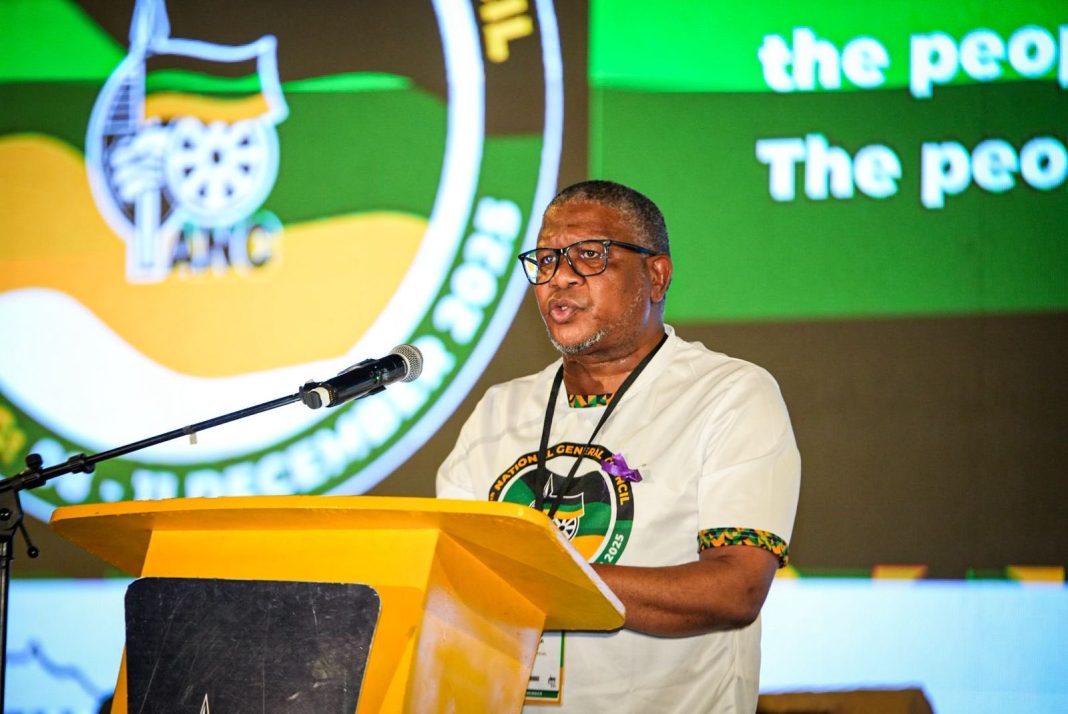
Delivering his Midterm Report at the ANC’s 5th National General Council (NGC) at the Birchwood Hotel and OR Tambo Conference Centre in Ekurhuleni on Monday, Mbalula said the organisation must confront weakening structures and declining public confidence.
“Strong working relationships with ward councillors perform better electorally. Conversely, comrades, weak branches contribute directly to electoral decline,” he told delegates.
Eastern Cape: stable but no longer guaranteed
According to Mbalula, the Eastern Cape remains “the province where support shows some consistency”, maintaining its historical status as a pro-ANC region.
Despite sustaining base support in most municipalities, the report warns that this cannot be taken for granted ahead of the 2026 elections, particularly because the province also contains pockets where opposition parties have successfully gained traction.
Mbalula warned delegates that although the Eastern Cape remains an anchor province, its reliability must not breed organisational complacency.
Free State: growth overshadowed by factionalism
Mbalula noted that the Free State has shown growth, but its performance continues to be weighed down by persistent factional disputes and governance challenges.
The report highlighted that while the province has the potential to rebound electorally, slow progress in stabilising ANC structures has hampered the party’s public image.
The organisation’s ability to consolidate recent gains remains dependent on resolving intra-party tensions and accelerating service-delivery improvements.
Gauteng: metros drifting from the ANC
Gauteng remains one of the ANC’s most difficult terrains.
While Mbalula acknowledged that support has recently stabilised, the overall trajectory reflects a long-term downward trend.
The report shows that ANC support is “mixed across regions, including the metros”.
Johannesburg, Ekurhuleni and Tshwane continue to drift away from ANC majorities, weakened further by perceptions of poor service delivery and fragmentation within the party’s regional structures.
He cautioned that without decisive political and organisational interventions, Gauteng could slip further, with direct implications for national electoral performance.
KwaZulu-Natal: large but slipping
KZN, one of the ANC’s largest and most influential provinces, has recorded steady declines over multiple election cycles. Mbalula cited shifting loyalties, the rise of regional parties and damaged public trust following the July 2021 unrest and municipal failures.
Limpopo: consistent support rooted in rural areas
Limpopo remains among the ANC’s most reliable bases, especially in rural municipalities. But the SG warned that steady support should not obscure the need for improved governance, better cadre deployment and targeted youth engagement.
Mpumalanga: slow recovery
Mpumalanga is rebuilding after a sharp decline caused by years of factionalism. Growth is visible but uneven. Mbalula warned that without intensified grassroots mobilisation, the ANC could continue to lose ground to opposition parties and new formations.
Northern Cape: modest but volatile
The Northern Cape is improving but remains unpredictable, with competition from the DA and smaller regional parties. Infrastructure collapse and water shortages continue to shake voter confidence.
North West: progress from a low base
The North West has recorded gains after prolonged instability, governance breakdown and weak provincial leadership. While stabilisation efforts are paying off, the province still needs “deep renewal” and stronger community engagement.
Western Cape: the ANC’s toughest terrain
Mbalula described the Democratic Alliance (DA)-run Western Cape as “the most challenging province for the ANC”.
Support remains low, especially in the City of Cape Town, where the DA continues to retain strong control.
Mbalula pointed to structural issues in ANC branches, inconsistent community outreach, and the party’s inability to penetrate mixed and historically marginalised communities that have increasingly shifted away from the movement.
The report also called for a fundamental reorientation of the ANC’s political strategy in the province.
INSIDE METROS