

By Johnathan Paoli
Differences over electoral strategy emerged during the 31st annual Joe Slovo Commemoration, where both the SACP and the ANC openly articulated their opposing views on the former’s decision to contest the upcoming local government elections independently, while simultaneously affirming that the move does not amount to a break from the Tripartite Alliance.
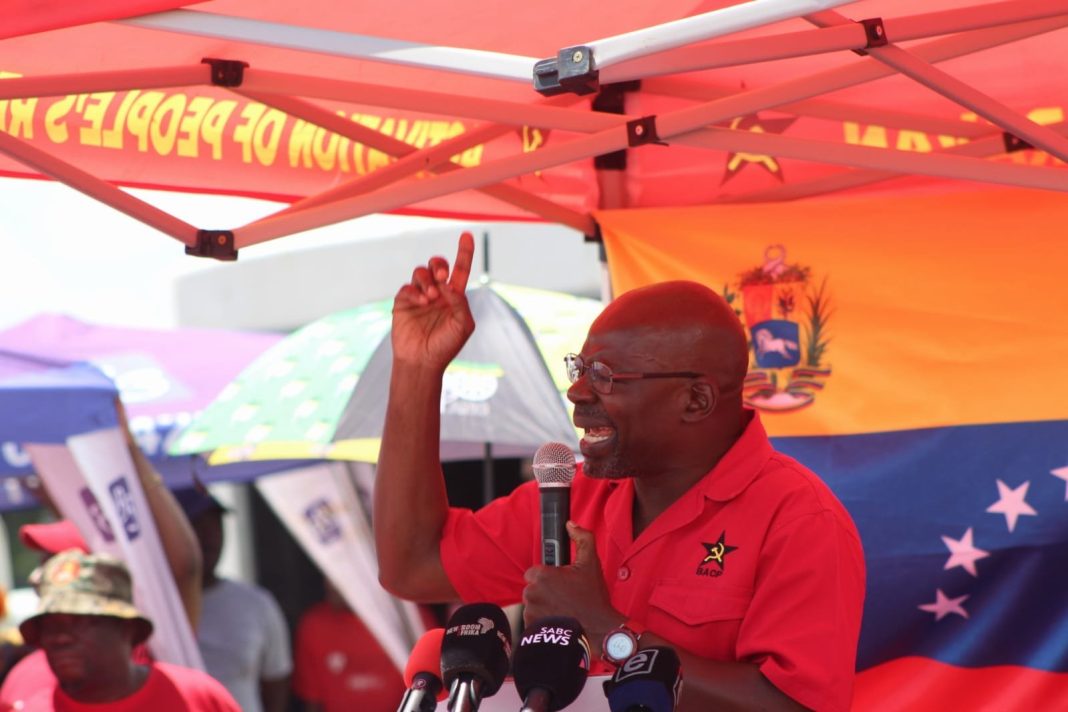
SACP General Secretary Solly Mapaila used his keynote address to defend the party’s decision as a necessary intervention to rescue working-class politics and restore credibility to local government, rejecting claims that the move signals hostility towards the ANC or an abandonment of alliance unity.
Earlier, ANC President Cyril Ramaphosa cautioned that the decision risks weakening the alliance and confusing voters, describing it as a strategic mistake; even as he stressed continued respect, dialogue and shared revolutionary purpose.
Mapaila framed the SACP’s electoral move as the product of more than two decades of internal debate, rooted in what he described as the collapse of local government and its devastating impact on the working class.
He argued that municipalities have become “a critical site of class struggle” marked by corruption, outsourcing, austerity and tender-based patronage.
“Our municipalities, which are the sphere of government closer to our people, are not in good shape,” Mapaila said.
He pointed to failing services such as water, sanitation, waste removal and local economic development, stressing that the SACP will contest the 2026 local government elections independently, as “a necessary option” rather than a symbolic gesture.
“This will not be another bureaucratic exercise. We are entering the burden of who governs at local government, and in whose interest,” the party leader said.
Crucially, Mapaila rejected the idea that the decision constitutes an attack on the ANC or the Tripartite Alliance.
Instead, he described it as “the exercise of working-class political independence within a greater unity of the alliance”.
Mapaila acknowledged that deep ideological contradictions exist within the alliance, particularly over economic policy, which he characterised as increasingly neoliberal and detached from the lived realities of the poor.
According to Mapaila, the liberation movement’s failure to secure economic power, despite holding political office, lies at the heart of persistent poverty, unemployment and inequality.
Mapaila was also emphatic in dismissing claims that the SACP’s move was driven by personal ambition or a desire for deployment into government, and rejected the narrative that the SACP is “going it alone”, insisting instead that it is “going with the people” by taking responsibility for grassroots struggles rather than delegating power to structures that no longer account to communities.
While defending the party’s independent electoral path, Mapaila repeatedly reaffirmed the SACP’s historic bond with the ANC, invoking the shared legacy of struggle forged alongside figures such as Slovo.
President Ramaphosa, however, struck a markedly different tone on the electoral question.
While acknowledging the SACP’s historic role and theoretical contribution to the ANC, he warned that contesting elections independently risks undermining the alliance’s collective strength.
“For him, that is Joe Slovo, the relationship between the ANC and the SACP was vital. And it was non-negotiable. Over many decades, the SACP has been central to refining the ANC’s strategic outlook,” Ramaphosa said.
Ramaphosa said the ANC respects the SACP’s decision but believes it is fundamentally flawed.
“The ANC is on record as saying the decision, which we respect, by the party to go in and run for elections on its own will be a historic mistake,” he said.
He warned that electoral fragmentation could weaken the alliance, confuse voters and ultimately jeopardise political power; but stressed that disagreement does not amount to separation.
Ramaphosa argued that the responsibility of Alliance leaders was not only to manage differences, but to actively protect unity, reiterating that renewal within the Alliance must occur collectively and not through fragmentation.
“Yes, we need to continue engaging because it is through engagement that we are able to find one another,” he said, adding that continued cooperation and mutual attendance at events demonstrated that dialogue remains intact.
Both leaders ultimately framed the dispute as one taking place within, rather than outside, the alliance.
INSIDE METROS