
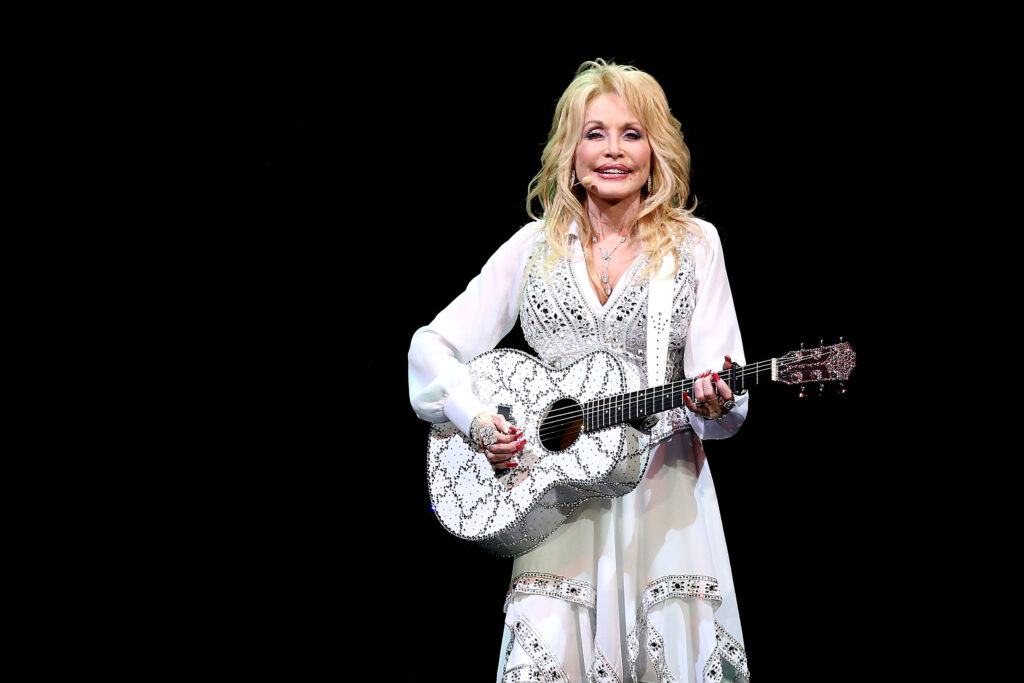
Dolly Parton, the effervescent and glamorous “Queen of Country” who emerged from extreme poverty in rural Tennessee to become one of America’s most distinguished songwriters and wealthiest self-made women, has died. She was 80.
She died today in Nashville, her publicist, True Public Relations, said in a statement. The New York Times reported the cause as cancer, citing her representatives. In May, she had cancelled a planned Las Vegas residency due to health issues that she said left her feeling “swimmy headed.”
With her platinum blonde wigs, sparkling outfits, hourglass figure and disarming one-liners that became known as Dollyisms, Parton became one of America’s most recognisable and beloved celebrities.
Her legendary songs included 9 to 5, I Will Always Love You and Jolene, which ranked as the best country song of all time by Rolling Stone. During a seven-decade career, she was inducted into the Country Music Hall of Fame, Rock & Roll Hall of Fame and Kennedy Center Honours for lifetime artistic contributions.
As a businesswoman, she presided over the creation of Dollywood, a theme park that became the most ticketed tourist attraction in Tennessee and largest employer in her home county of Sevier. She sold over 100 million records worldwide and had an estimated net worth of $450 million, according to Forbes.
“She has crossed musical class lines to bring work, real life and strong women into a world of pop music usually dominated by unreal romance,” Gloria Steinem, a founding editor of the feminist magazine Ms., wrote of Parton in 1987.
“She has used her business sense to bring other women and poor people along with her. And her flamboyant style has turned all the devalued symbols of womanliness to her own end.”
President Donald Trump ordered US flags to be flown at half staff for a week in Parton’s honour, saying in a social media post that “there has never been anyone like her, and never will.”
In concert, Parton captivated audiences with rapturous sing-a-longs, poignant allegories and nostalgic oldies while alternating among up to 20 instruments including the banjo, dulcimer, autoharp and pan flute.
Between songs, she’d humour her fans with Dollyisms about her extensive plastic surgery or childhood poverty (“we had running water if we’d run and get it!) and encourage them to find contentment through acceptance and forgiveness.
“She reminds her audiences that, no matter where they came from, everyone can identify with being shamed one way or another, and no one deserves it,” Sarah Smarsh wrote in She Come By It Natural: Dolly Parton and the Women Who Lived Her Songs (2020).
“If her presence and the appreciation it instils in people could be whittled to a phrase, it’s ‘Be what you are.’”
The charm and quick wit that Parton oozed in interviews and public appearances masked a determined musician who upended the male-dominated world of country music.
When Parton signed her first record deal as a teenager in 1962, there were no federal protections against sex-based wage differentials for equal work or sex discrimination in the workplace.
“Being a woman always served me well,” Parton told Out Magazine in 1997.
“I don’t mind that it’s a man’s world, as long as they don’t mind if we run it.”
Dolly Rebecca Parton was born on Jan. 19, 1946, in a log cabin home in Sevier County, Tennessee, the fourth of 12 children to Robert Lee Parton, an illiterate day labourer and subsistence farmer, and Avie Lee Parton, a home-maker.
Parton loved recalling that her father paid Dr. Robert F. Thomas – the local physician she’d commemorate in a 1973 song – with a sack of cornmeal.
The family eventually moved to a two-room cabin with no electricity or running water on a tobacco farm in nearby Locust Ridge.
Parton commemorated her rural upbringing in her 1973 autobiographical album My Tennessee Mountain Home, a pastoral reminiscence of homemade toys, wooden stoves and fragrant honeysuckle as well as the impoverished circumstances that required all 12 Parton children to work on the family farm and sleep three or four to a bed.
The album’s title track was designated an official Tennessee state song in 2022.
Parton’s mother guided family sing-a-longs with songs from her Cherokee lineage and other British/Elizabethan and Irish folk standards traced to the Appalachian tradition.
Parton started singing as a toddler and composed her first song, a dedication to her corncob doll with corn-silk hair, around age 6. On Saturday nights, the family huddled around the farm’s battery-operated radio to listen to broadcasts of the Grand Ole Opry from Nashville.
Honing her vocals in her grandfather’s church, Parton caught the attention of her uncle Bill Owens, a guitarist who became her future songwriting partner. Owens helped secure the 10-year-old Parton a regular spot on The Cas Walker Farm and Home Hour, a Knoxville radio and television show. In 1959, Parton performed at the Grand Ole Opry for the first time and recorded her first singles, Puppy Love and Girl Left Alone.
After graduating high school in 1964, Parton moved to Nashville, where she met Carl Dean, an asphalt paver. The two eloped in 1966. As Parton rose to stardom, Dean’s aversion to publicity led some journalists to speculate that he didn’t exist. The two remained married until his death in 2025.
Parton soared to country stardom in the late 1960s and early 1970s with yearning heartache ballads, humorous critiques of apathetic husbands and harrowing stories of abandoned and abused women. Her 1967 single Dumb Blonde — one of her few songs from that era that she didn’t write herself — warned listeners that “just because I’m blonde, don’t think I’m dumb, ‘cause this dumb blonde ain’t nobody’s fool.”
That early work earned the attention of Porter Wagoner, whose self-titled variety show was a marquee act in the Nashville country music scene. The two performed together for seven years and recorded seven albums. “I could sing when I met Porter,” Parton wrote in her 1994 autobiography, Dolly. “After knowing him, I knew how to perform.”
Bandmates and family members recalled Parton writing songs on dry cleaner tickets, restaurant napkins and candy bar wrappers, one of which became her 1971 single Coat of Many Colours, a childhood memory of a garment sewn from rags by her mother to resemble Joseph’s coat of many colors from Genesis.
Eager to assume control of her solo career, Parton agonised about how to tell Wagoner she was leaving the show due to a deteriorating relationship that she later compared to a failing marriage. “How am I gonna make him understand how much I appreciate everything, but that I have to go?” Parton told The Tennessean. “So I went home and I thought, ‘Well, what do you do best? You write songs.’ So I sat down and I wrote this song.”
That song, I Will Always Love You reached No. 1 on the country charts in 1974 and again in 1982 after Parton re-recorded it for The Best Little Whorehouse in Texas, which starred her and Burt Reynolds.
Parton originally agreed to let Elvis Presley cover the song before learning that his management wanted half of the publishing rights. Parton rejected the proposal and maintained full copyright. That decision paid off when Whitney Houston’s cover of the song, for The Bodyguard (1992), spent 14 consecutive weeks as the No. 1 song on the Billboard Hot 100.
Parton said it was possible she wrote I Will Always Love You on the same day as Jolene, her plea to an auburn-haired beauty to stop trying to steal her husband. Parton’s second No. 1 single on the country charts, Jolene was later covered by artists including Beyoncé, The White Stripes and Olivia Newton-John.
Dolly Parton albums at The GRAMMY Museum in Los Angeles in 2019. Photographer: Jesse Grant/Getty Images
In 1976, Parton ended her working relationship with Wagoner, who had continued producing Parton’s records after she left his TV show. Wagoner sued her for $3 million for breach of contract and savaged her in the press for disloyalty. The two eventually settled for $1 million and made up before Wagoner’s death in 2007.
Parton signed with the Los Angeles talent agency Katz-Gallin-Cleary, which represented pop artists like Cher and The Osmonds and moved her album production from Nashville to Los Angeles.
With her new band, Gypsy Fever, she recorded the 1977 album Here You Come Again, which added disco stylings to her traditional country sound and became her first album to be certified platinum by the Recording Industry Association of America. The title song won Parton the first of her 10 Grammy Awards.
Her first No. 1 single on the Billboard Hot 100 came three years later when she released 9 to 5, the title track of the 1980 comedy starring Parton, Jane Fonda and Lily Tomlin about three women’s quest for vengeance against their chauvinist boss. It was Parton’s first acting role. The song, which earned an Academy Award nomination, became a rallying cry for a generation of women facing sexism in the workplace.
She recorded her second No. 1 three years later with Islands in the Stream, a duet with country star Kenny Rogers.
In a 1982 interview with Barbara Walters, Parton declared that she wanted to open a theme park in her home town — “like Disneyland, only it will be in the Smokey Mountains.” Four years later, Parton joined the operators of Silver Dollar City, a theme park in Pigeon Forge, to convert it into Dollywood, which she hoped would boost employment in Sevier County.
“A lot of my businesspeople said: ‘That’s a big mistake, that is a great way to lose all your money,’” Parton told Reuters in 2016.
“Then I got rid of those lawyers and accountants who didn’t believe in me, and got new ones who did. Needless to say, it’s been the biggest and best investment I ever made.”
A 2021 study by Tennessee’s Department of Transportation estimated that Dollywood was welcoming 3 million visitors a year and had an annual economic impact of $1.8 billion for the region.
Parton earned another Oscar nomination in 2006 for her song Travelin’ Thru from the soundtrack of Transamerica, a road trip movie about a trans woman reconnecting with her estranged son, which angered her more conservative fans. “Having a big gay following, I get hate mail and threats,” she told the Tenneseean.
“Some people are blind or ignorant, and you can’t be that prejudiced and hateful and go through this world and still be happy. One thing about this movie is that I think art can change minds. It’s all right to be who you are.”
For decades, journalists asked Parton if she ever considered entering politics because of her widespread popularity.
She deflected with one of her most popular Dollyisms: “I think we’ve had enough boobs in the White House.”
She consciously avoided the term “feminist,” finding it too politically charged and electing to describe herself as a “woman in business” instead.
As a philanthropist, Parton started the Imagination Library, which has given more than 300 million free books to children under 5 since its inception in 1995.
In 2020, she donated $1 million to Vanderbilt University Medical Center to support its work with drug maker Moderna to develop one of the first coronavirus vaccines.
She also donated $1 million to recovery efforts after Hurricane Helene ravaged East Tennessee in 2024. She supported animal welfare through her pet product line, Doggy Parton.
Parton had declared that there was “no way that I would ever retire,” and she was planning a major tour in 2025 when a series of health issues forced her to cancel.
BLOOMBERG