
By Thapelo Molefe
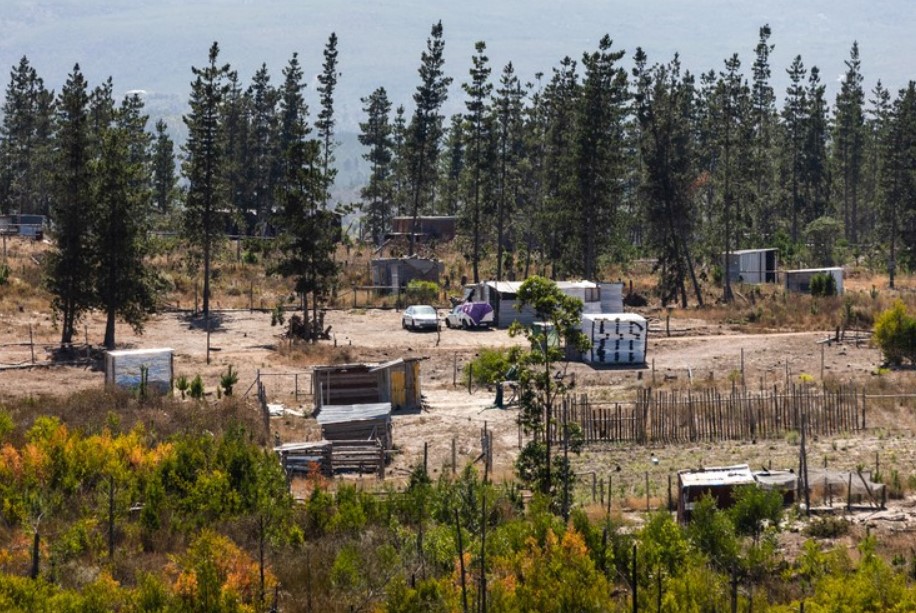
The Department of Public Works and Infrastructure has spent more than R63 million on private security and court enforcement linked to the occupation of Knoflokskraal in the Western Cape, with Minister Dean Macpherson warning that the costs are eating into funds meant for service delivery.
The department spent more than R58 million on private tactical security between April 2021 and June 2026, while another R5.47 million went towards sheriff fees for enforcing and serving court orders.
“These are enormous amounts of public money,” Macpherson said at a press conference on Monday.
“They demonstrate the consequences of allowing a situation to continue without a sustainable resolution, as well as the costs associated with ignoring the rule of law.”
He said the security expenditure had been taken from the department’s baseline budget and other service delivery programmes.
“This cannot become the permanent model of governance at Knoflokskraal,” he said.
The government plans to approach the Western Cape High Court on 19 October to stop further occupation, construction and unlawful land sales on the site near Grabouw.
Macpherson said the application followed years of failed attempts to contain the occupation through court orders and engagement with community representatives.
The application will seek to prevent new structures from being built, building materials from being brought onto the site for further construction, and the unlawful sale or allocation of state-owned land.
“Containment is not eviction. It is about freezing the situation to prevent it from deteriorating further,” he said.
Knoflokskraal comprises six state-owned farms covering approximately 2,000 hectares. The land falls under the department’s custodianship and was historically intended for forestry, job creation and economic development.
The occupation began during the Covid-19 lockdown in late 2020. Despite court orders obtained in 2021 to contain it, the settlement continued to grow. Macpherson said the number of structures increased from about 382 in May 2021 to about 4,880 by August 2022.
Attempts to negotiate with community representatives failed, with an in-principle agreement to enter into a social compact agreement in December 2025 ultimately collapsing amid divisions between competing leadership structures.
The government later began engaging directly with residents. However, Macpherson said attempts to establish communication channels were met with resistance and violence.
On 15 May, a contractor attempting to install repurposed containers at access points encountered a hostile crowd. One container was set alight, a security guard house was damaged and a security officer was allegedly assaulted with a crowbar.
Despite these difficulties, the department received information from whistle-blowers alleging that state-owned land was being illegally subdivided and sold for approximately R1,500 per plot.
Macpherson said the government had received a database containing details of about 820 people who had allegedly bought or received land allocations through the suspected system. The department also received allegations of unlawful levies collected from residents.
“If someone is fraudulently selling state land that they do not own and have no authority to allocate, or collecting unlawful levies in connection with that land, they are not helping vulnerable people obtain land. They are exploiting them,” he said.
The government also received information about an unauthorised parallel policing structure allegedly performing functions reserved for the South African Police Service (SAPS). The allegations include paramilitary-style training facilities, violence, intimidation and threats against government officials, contractors and emergency personnel.
“When firefighters cannot safely respond to a fire, when contractors cannot safely access government property, and when officials cannot perform their lawful duties, the state has a responsibility to act,” Macpherson said.
In July, he submitted a criminal complaint affidavit to SAPS, supported by whistleblower disclosures and security reports.
The planned court application will also seek an order prohibiting violence, intimidation and harassment, and requiring SAPS to assist with enforcing court directives and maintaining public order.
The government wants an independent social facilitator to establish who lives on the land, their circumstances and any vulnerabilities that should be considered. Macpherson said the process would ensure that the government’s response was lawful and that affected residents had an opportunity to be heard.
“The appropriate response is therefore not arbitrary action. It is a lawful, evidence-based and judicially supervised process,” he said.
The government intends for the substantive hearing to take place in February 2027, subject to the court’s direction. This would give affected residents time to study the court papers and obtain legal representation.
Macpherson said the department had spent six months preparing an affidavit of more than 1,000 pages detailing the history of the occupation, previous court orders, failed interventions and allegations uncovered through investigations.
“Ultimately, it will be for the court to consider the evidence and determine what relief is appropriate,” he said.
INSIDE METROS