By Moyahabo Mabeba
Polokwane Local Municipality is entering a new political era as a hung council forces the African National Congress (ANC) to rely on coalition partners to retain control of the Limpopo capital, amid growing concerns from the business sector over the city’s sluggish economic growth and its ability to attract investment and create jobs.
The sixth administration takes office at a critical juncture, with business leaders expressing concern about what they describe as the city’s stagnant or snail’s-pace economic growth under successive ANC-led administrations.
The coalition follows the November 4 local government elections, in which the ANC suffered its worst electoral decline in Polokwane, losing its outright majority for the first time.
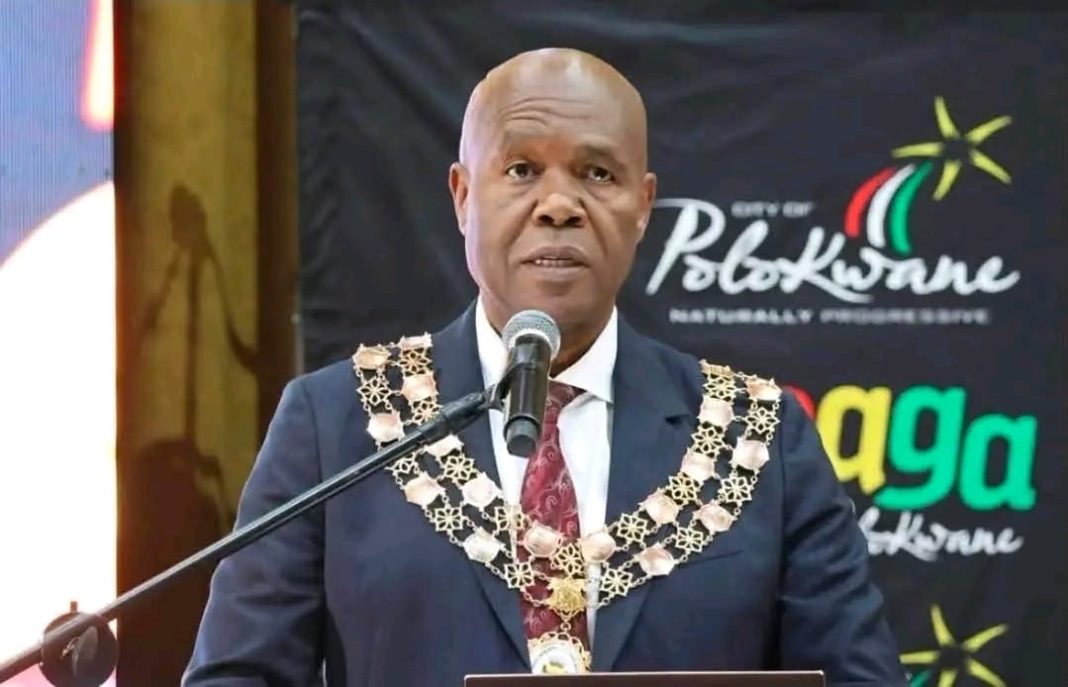
Despite the decline, the party retained control of the municipality’s top leadership positions, with Makoro John Mpe reclaiming the mayoral chain after being re-elected executive mayor.
Lizell Whitehead and Adolf Rapetsoa were elected speaker and chief whip, respectively.
During Tuesday’s council sitting at Jack Botes Hall, Mpe defeated EFF provincial leader Lawrence Mapoulo by 55 votes to 35.
The 90-seat council reflects a significant shift in the city’s political landscape.
The ANC secured 37 seats, with 41.24% of the vote, down from 56 seats and 60% in 2021.
The Economic Freedom Fighters (EFF) followed with 17 seats, while the Democratic Alliance (DA) won 11, ActionSA secured 10 and the South African Communist Party (SACP) claimed six seats.
As part of its coalition arrangements, the ANC struck agreements with the DA and the Freedom Front Plus (FF Plus), allocating them two and one positions on the mayoral committee, respectively.
The DA will oversee the finance and special development portfolios.
However, beyond the political negotiations, the new administration faces pressure to address the city’s economic challenges and unlock its potential as Limpopo’s administrative and commercial hub.
The business sector acknowledges that Polokwane’s economy is growing, but says the pace remains slow. The city’s unemployment rate currently stands at 22.24%.
The Limpopo Chamber of Commerce and Industry (LCCI) believes the economic future of Polokwane should transcend party-political interests.
The organisation’s president, Dr Albert Jeleni, says that, irrespective of the municipality’s political configuration, the collective responsibility of its leadership must be to create an environment conducive to investment, business growth, job creation and inclusive economic development.
“Polokwane is already the administrative and commercial capital of Limpopo. However, its ambition should extend beyond being predominantly an administrative and consumption-driven economy to becoming a competitive centre of production, investment, innovation, logistics and trade, serving the entire province and positioning itself as a gateway to the broader Southern African economy.
“The new political chapter presents an opportunity to rethink how the municipality approaches economic development, particularly in political and administrative stability, good governance and policy certainty. The municipality should commit itself to reliable infrastructure and efficient municipal service delivery, as well as meaningful inclusion of the private sector in economic planning and implementation,” he says.
Jeleni says while a multiparty governance arrangement presents opportunities for broader participation, it also carries risks if political contestation is allowed to undermine institutional stability, decision-making and service delivery.
“Our expectation is that political parties will find common ground around the economic interests of the city and its residents. Businesses require certainty, predictability and a functional municipality, regardless of who occupies political office.
“As the LCCI, we stand ready to work with the incoming leadership and other stakeholders to develop a shared economic agenda that positions Polokwane not merely as a prosperous city, but as a catalyst for the prosperity of Limpopo as a whole.
“Ultimately, the success of this new political chapter should be measured not by who occupies political positions, but by whether businesses thrive, investments increase, jobs are created and the quality of life of ordinary citizens improves,” says Jeleni.
Lerato Sekgobela, chairperson of the Polokwane Tourism Association, says the hospitality industry remains a significant but underutilised economic driver in the city.
She says tourism has considerable potential to stimulate local economic growth by creating jobs, attracting investment and supporting small, medium and micro enterprises (SMMEs).
“As the economic hub of Limpopo and a strategic gateway to key tourism destinations across the province, Polokwane benefits from its hospitality establishments. However, the sector’s contribution to the local economy is constrained by limited destination marketing, inadequate tourism infrastructure, insufficient investment in visitor experiences, weak coordination between stakeholders and government, and the need for stronger support for emerging tourism businesses.
“There is an opportunity to reposition tourism as a priority economic sector rather than treating it as an occasional promotional activity.
“The new political administration has an opportunity to change this trajectory by placing tourism at the centre of its local economic development agenda. Most importantly, tourism must be recognised as an economic sector with measurable targets for visitor growth, spending, investment and sustainable job creation.
“The tourism sector is ready to work with the new administration as a strategic industry partner to build a competitive, inclusive and vibrant tourism destination that benefits businesses, communities and the broader economy of Polokwane,” says Sekgobela.
The Forum for Limpopo Entrepreneurs, meanwhile, says Polokwane has been on the brink of a political meltdown following years of factional battles among ANC leaders over corruption and tender allocation.
The forum’s leader, Siviko Mabunda, says recurring service delivery protests over chronic water shortages are among the problems confronting the municipality.
“The economic growth of Polokwane is hindered by rampant corruption, where comrades steal with impunity. That’s the reason for the first time it became one of the hung councils. People of Polokwane are sick and tired of the corruption and stealing that is happening in that municipality. That is why they decided to punish the ANC at the polls,” says Mabunda.
In his acceptance speech, Mpe said his administration would prioritise investment attraction and the creation of new economic opportunities.
He pointed to several proposed and ongoing developments that he said would help reshape the city’s economic and spatial landscape.
“Through our partnerships with the private sector, the municipality is implementing projects that will reshape the economic and spatial landscape of Polokwane through the Green Arch Precinct development, which is set to create 3,000 jobs during construction and an estimated 360 permanent jobs thereafter.
“The proposed development of the medical node in Grobler Street, which is expected to accommodate seven new private hospitals, will stimulate investment in healthcare infrastructure.
“The June 2026 investment portfolio already identifies two new hospital investment pledges worth R260 million, with an estimated 1,550 construction jobs and 275 permanent employment opportunities.
“Through all these catalytic projects, we have seen cranes hovering through the skies of our city, attracting investment, growing the local economy and creating the much-needed jobs. We cannot build impressive developments while our own people remain locked outside the gates of economic participation,” he said.
Mpe also urged newly elected councillors to pursue further education and professional development, saying effective municipal governance requires an understanding of legislation, policies and the technical demands of service delivery.
“I wish to state that the responsibility of a councillor does not end with winning an election. It begins with understanding the communities we represent, the legislation that governs municipalities, the policies that guide our work and the technical matters that affect service delivery. I therefore encourage every councillor, particularly those who may not yet have acquired post-matric qualifications.”
INSIDE METROS