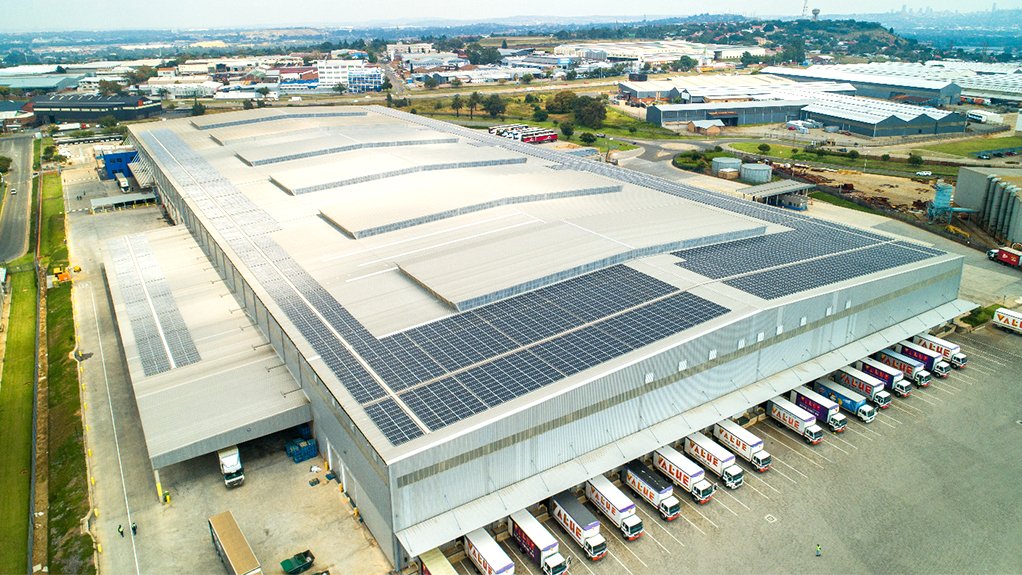
THE Ekurhuleni municipality has approved the connection of a large solar photovoltaic (PV) plant and battery system at food and beverage company PepsiCo Sub-Saharan Africa’s (SSA’s) large distribution centre, near Kempton Park.
The new PV and lithium-ion battery system will form one of South Africa’s largest microgrids, comprising a 1.8 MW solar PV facility alongside a 2.9 MWh battery, while being grid-connected to stabilise the local grid.
“This approach and investment into renewable energy forms part of our PepsiCo positive journey – a strategic end-to-end transformation with sustainability at the centre of how the company will create growth and value,” said PepsiCo SSA engineering sustainability lead Umesh Himraj.
PepsiCo SSA procured the system from solar power company SOLA, which engineered and built the microgrid system, to secure energy supply and reduce carbon emissions, calling it a “landmark project” in the renewable energy space.
“The solution that we devised uses the roof space at PepsiCo’s facility to house solar modules, which generate enough solar electricity during the day to run the plant entirely, and store excess power in the battery. The solution provides near 100% renewable energy for this facility,” said SOLA CEO Dom Wills.
Historically, while microgrids have been appealing, they’ve proved to be an expensive option for businesses.
However, the substantial cost reductions in renewable energy technology, alongside grid unreliability and rising electricity tariffs, have made them more feasible for large energy consumers.
PepsiCo saw the risk of load-shedding, which amounted to more than 1 130 hours last year, as significant enough to warrant the investment in the microgrid.
“We didn’t expect it to be financially viable for large energy consumers to completely defect from the grid for another two years. However, after years of compounded electricity price increases, this investment is turning out to be lucrative for large energy consumers, providing cheaper power and immunity from load-shedding.
“In addition, many companies have sustainability targets and are looking to make their operations more environment-friendly,” Wills said.
Despite the plant being completely off-grid, the renewable energy system has also received the requisite municipal and National Energy Regulator of South Africa approvals to connect to the grid, which will allow PepsiCo to sell excess energy back to the municipality.
Wills noted that large-scale energy storage solutions were imperative for high renewable energy penetration, as they enabled the consistent supply of power and combatted intermittency.
SOLA has completed several other microgrids in Southern Africa, the most notably being the microgrid on Robben Island, in the Western Cape.
- – Engineering News