By Thapelo Molefe
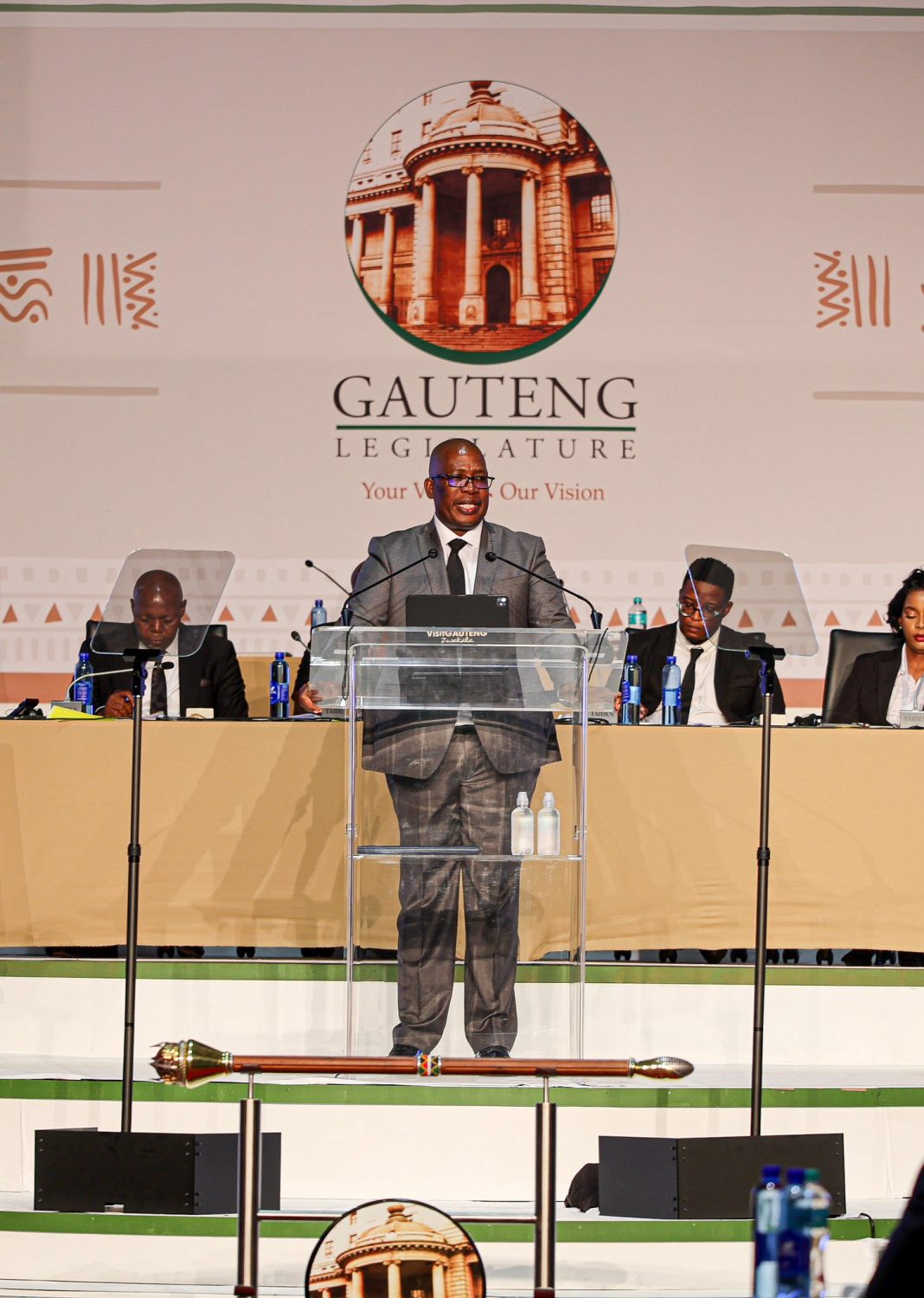
Gauteng premier Panyaza Lesufi has outlined an ambitious plan to rescue the province’s struggling municipalities, announcing new interventions to address governance failures, eliminate potholes, restore traffic lights and tackle the mushrooming of informal settlements ahead of the 2026 local government elections.
Delivering his 2026 State of the Province Address, Lesufi acknowledged that local government remains the weakest link in the delivery chain despite being “the backbone of service delivery.”
“Let us face it; local government is the backbone of service delivery, and yet this is exactly where we are most challenged as government,” Lesufi said.
The address comes as coalition politics continues to destabilise several municipalities, with Ekurhuleni facing fresh governance turmoil and a motion of no confidence tabled against the Sedibeng executive mayor Lerato Maloka.
Lesufi addressed the political instability head-on, acknowledging that “developments in Ekurhuleni over the last few days have brought coalition governance into sharp focus.”
He said discussions with municipal leadership had yielded assurances that governance challenges would be resolved “without further delay,” and welcomed moves to hold accountable those implicated in the Madlanga Commission of Inquiry.
In Sedibeng, where the Pan Africanist Congress tabled a motion of no confidence against the executive mayor Maloka, Lesufi said the governing party was “proposing changes in some municipalities under its control.” He announced that discussions with affected municipal leaders were scheduled for later this week.
Despite the political turbulence, Lesufi highlighted service delivery progress. Ekurhuleni recently invested in a new fleet for refuse removal, road maintenance and law enforcement, while Emfuleni Municipality unveiled 145 new vehicles to accelerate services.
The country’s largest metro is now subject to a Presidential Working Group intervention aimed at addressing “service delivery failures, infrastructure decay and financial instability.”
Lesufi welcomed the intervention and pointed to incoming investments, including a R7 billion waste-to-energy project secured with Netherlands partners.
As part of revitalising the Johannesburg CBD, the provincial government is escalating refurbishment of 18 government-owned buildings. The R8 billion programme will unfold over 30 months and create more than 2,500 construction jobs.
In contrast to its troubled neighbours, the City of Tshwane received praise from the premier.
Lesufi welcomed the Tshwane Mayoral Committee’s decision to reimburse workers for long-outstanding benefits, describing it as evidence that the municipality “respects bargaining council resolutions.”
“Over R1 billion in backdated salary increases will be returned to workers,” he said, adding that the municipality had cleared all outstanding payments to Eskom and Rand Water and now operates on a funded budget.
To coordinate development across municipalities, Lesufi announced the establishment of a Bulk Infrastructure Agency.
“We highlighted in the 2025 SOPA that bulk infrastructure is a catalyst for development and yet remains uncoordinated,” he said.
“Gauteng will be establishing a Bulk Infrastructure Agency that will coordinate and manage the provision of bulk infrastructure in the province with the assistance of all our municipalities.”
The premier reported progress on visible service delivery issues that frustrate residents daily.
Of 31,000 identified potholes, 26,000 have been repaired across the province. To accelerate repairs, Lesufi announced that the province and municipalities would pool resources to use asphalt plants owned by Johannesburg and Tshwane.
“Going forward, we have appointed the three metros of Tshwane, Johannesburg and Ekurhuleni to fix potholes on our provincial roads within their jurisdictions,” he said.
On traffic lights, the province now has 4,786 functional signals, with 699 still requiring repair. Lesufi acknowledged a “vicious cycle” of vandalism undermining progress.
“We fix them, and they get vandalised,” he said, announcing a pilot with the CSIR to test alternative technology resistant to theft.
To ensure subsidies reach the poorest residents while identifying those who can afford to pay for services, the province has developed an e-indigent register.
The system has been piloted in Mogale City, Rand West and Merafong, with full rollout planned later this year.
“With this system coming live later this year, the current challenges faced by the residents of Tembisa will be removed immediately,” Lesufi said.
“Those that cannot afford to pay for municipal services will benefit, and those that can afford will be encouraged to pay.”
Lesufi took a hard line on the growth of informal settlements, announcing that “all law enforcement agencies and municipalities will not allow the building of new informal settlements in our province.”
A multi-disciplinary team has been established, with Plastic City in Ekurhuleni, housing over 2,500 people, the first settlement removed. An attempt to address Plastic View in Tshwane was unsuccessful but will be revisited later this year.
“We cannot allow our beautiful province to be reduced to a shanty town,” Lesufi said. “We are against the ‘Mkhukhu’ mafias who are taking advantage of our people.”
The province has acquired 200 hectares of land to upgrade Makause informal settlement in Ekurhuleni, with land transfer to the municipality underway.
In Tshwane, 33 hijacked municipal buildings have been identified, with seven reclaimed and put to market. Twelve properties covering 2.7 hectares in Marabastad have been demolished.
“Marabastad plays a crucial role in the history of our country and cannot be forfeited to illegal foreigners,” Lesufi said.
Lesufi assured West Rand residents that the province is working with the municipality to address ongoing sinkhole damage, with relief measures underway following a national government declaration.
Illegal mining has reached “intolerable levels,” with over 600 families fleeing their homes in January due to violence by what Lesufi called “marauding gangsters.”
“Dangerous syndicates use high-calibre weapons such as AK-47s to conduct hostile takeovers of illegal mining sites,” he said. “Government will put a stop to this terror.”
He welcomed President Ramaphosa’s directive to deploy the SANDF to Gauteng, confirming soldiers have arrived in the province. A recent joint operation recovered 75 AK-47 rifles and ammunition.
Amid the challenges, Lesufi singled out Midvaal Local Municipality for praise.
“Let us take this opportunity to congratulate Midvaal Local Municipality for continuing to be the shining municipality in our province, but most importantly for their strong belief in Integrated Governmental Relations and participation in provincial programmes.”
The West Rand District Municipality also received commendation for attaining its second consecutive clean audit.
As part of reducing dependency on tenders, the province is training 2,500 young people to perform basic maintenance on public infrastructure.
“Today we will unveil 500 of the 2,500 young people who will be employed to fix broken taps, paint public paving, and fix broken toilets,” Lesufi announced.
A new paperless procurement system called TenderSwift has been introduced to reduce human interference in tender processes, which Lesufi identified as the source of most corruption.
With local government elections scheduled for 2026, Lesufi’s address positioned the provincial government as actively intervening to rescue failing municipalities while taking credit for progress in areas like crime reduction, investment attraction and infrastructure development.
The premier ended with a quote from Nelson Mandela: “Do not judge me by my successes; judge me by how many times I fell down and got back up again.”
INSIDE METROS