By Charmaine Ndlela
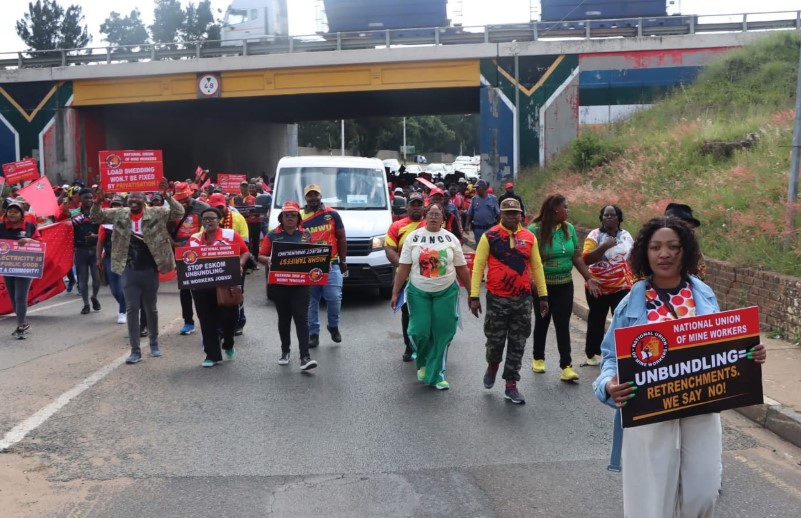
The National Union of Mineworkers (NUM) PWV region took to the streets of Newtown, Johannesburg on Saturday, intensifying opposition to Eskom’s unbundling and also protesting economic pressures facing workers.
Led by NUM General Secretary Mpho Phakedi, the march saw workers mobilise in large numbers towards the Gauteng Premier’s Office, where a memorandum of demands was handed over, calling for urgent government intervention.
A parallel march took place in Polokwane under the leadership of Deputy General Secretary Phillip Mankge.
This follows Eskom’s restructuring plan, which seeks to split the utility into three entities: generation, transmission and distribution. While government maintains the move is aimed at improving efficiency and competitiveness, unions argue it is a gateway to privatisation.
In its memorandum, NUM stated that the unbundling process “threatens job security, weakens collective bargaining structures, and undermines South Africa’s energy sovereignty”.
Workers also raised alarm over widespread labour law violations, particularly in the construction and metal sectors, where non-compliance with the Basic Conditions of Employment Act and Labour Relations Act remains a concern.
The union further highlighted the crisis in the mining sector, including shafts placed under care and maintenance, which it says has led to prolonged uncertainty, job losses and increased safety risks.
The Congress of South African Trade Unions (COSATU) threw its support behind NUM, warning that Eskom’s restructuring risks favouring private interests over workers.
“We are against the unbundling of Eskom because once government introduces programmes that are supported by capital, you must know they do not serve the interests of the working class,” said COSATU Deputy General Secretary Cde Gerald Twala, at the march.
Twala added that weakening state-owned entities creates a pathway for privatisation, which unions say must be resisted.
The South African National Civic Organisation (SANCO) echoed similar concerns, warning that communities stand to bear the brunt of privatisation.
“Privatisation of state institutions like Eskom threatens job security, fair wages and decent working conditions. For communities, particularly the poor and rural, it means higher electricity costs, reduced access and the erosion of electricity as a basic right,” said Nomonde Shivabu, representing SANCO
The organisation added that energy should remain a public good.
“We call for solutions that strengthen Eskom as a public entity, improve efficiency and expand access to affordable electricity, rather than handing control to private interests,” Shivabu said.
NUM’s memorandum also raises concerns about instability at major industrial players such as ArcelorMittal, warning of potential job losses and criticising what it describes as inadequate government intervention.
Workers also pointed to the prolonged business rescue process at Cast Products South Africa, citing unpaid wages, job insecurity and poor oversight.
Rising electricity tariffs remain a major point of contention, with the union arguing that escalating costs are placing significant strain on households already grappling with high food prices, transport costs and interest rates.
Additional grievances include taxation on overtime and retirement withdrawals, delays in the gazetting of collective agreements, and the impact of imports on local industries.
NUM is demanding an immediate halt and review of Eskom’s unbundling process, stricter enforcement of labour laws, and targeted interventions to stabilise key industries and protect jobs.
The union has given government 14 days to respond to its demands and engage on a concrete action plan.
INSIDE METROS