

South African business sentiment dropped to a two-year low in the third quarter, reflecting elevated uncertainty as conflict in the Middle East rages on and domestic demand falters.
The quarterly business confidence index compiled by FirstRand’s Rand Merchant Bank and Stellenbosch University’s Bureau for Economic Research dropped a point to 38 in the three months through September, according to a report published Wednesday.
The reading is the weakest since the third quarter of 2024, the data show.
“Business confidence has stabilised, but at a level that remains too low to support the stronger investment and employment growth South Africa needs,” said Isaah Mhlanga, chief economist at RMB.
“A sustained improvement will require better demand conditions, continued reform progress and greater certainty in the operating environment, particularly at local government.”
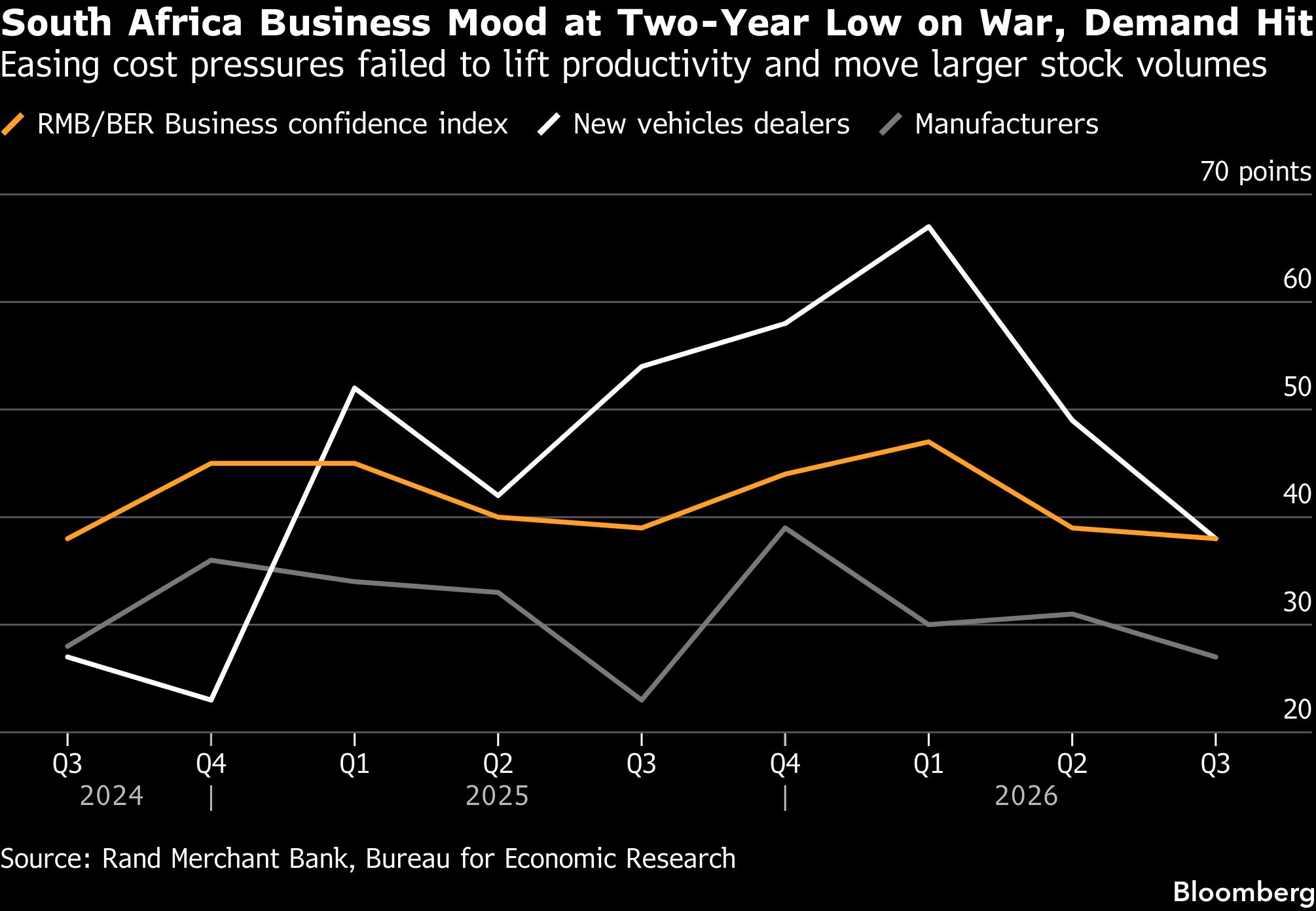
Confidence slipped in four of five sub-indexes, with sentiment among new-vehicle dealers taking the biggest knock.
The index dropped 11 points to 38 as stock levels exceeded demand and stronger new-vehicle sales was almost offset by weaker sales in the second-hand market.
Sentiment among manufacturers soured the second most. The index fell to 27 from 31 in the previous quarter as local demand remained weak and export volumes deteriorated amid slower global growth.
“Capacity utilisation also decreased, suggesting that manufacturers continue to operate with significant spare capacity,” RMB said.
The survey was conducted during the latter half of August, as pressures triggered by the earlier oil shock stemming from the war in Iran were subsiding, and inflation moderated.
Policymakers at the central bank also decided to leave the benchmark policy rate at 7%, after a May hike of 25 basis points due to economic-growth concerns and downward revisions to their inflation assumptions.
“Some of the acute pressures that weighed on sentiment in the second quarter have eased, particularly input costs,” Mhlanga said.
“This has not yet translated into a broad improvement in demand or activity. The sectoral picture remains mixed, and businesses are still grappling with uncertainty around both the global environment and domestic operating conditions.”
He added that the November 4 local government elections will be a crucial marker for sentiment in the final quarter of the year because of broader uncertainty about municipal governance and service delivery.
“Heightened uncertainty could further delay spending and investment decisions,” the lender said.
BLOOMBERG