
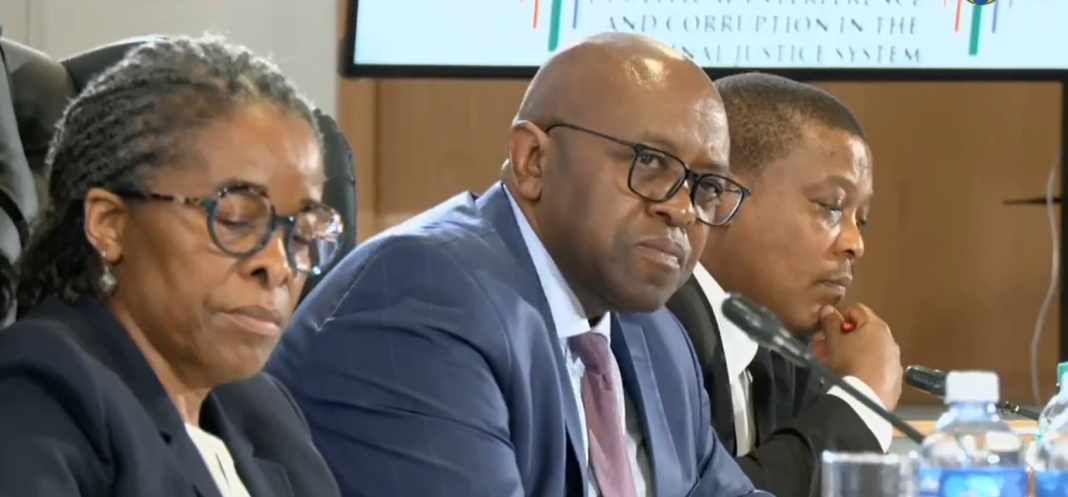
 acting national head of investigations, Thuso Keefelakae, told the Madlanga Commission on Wednesday that legal gaps, limited forensic capacity, and chronic resource constraints were undermining the watchdog’s ability to investigate police and municipal police officers.)
By Johnathan Paoli
Independent Police Investigative Directorate (IPID) acting national head of investigations, Thuso Keefelakae, told the Madlanga Commission on Wednesday that legal gaps, limited forensic capacity, and chronic resource constraints were undermining the watchdog’s ability to investigate police and municipal police officers.
Keefelakae said IPID can take over investigations to avoid conflicts of interest, citing cases such as domestic violence incidents involving police couples stationed at the same unit, where his team intervenes to prevent “interference”.
ALSO READ: O’Sullivan on the defensive: five things that irked MPs
But he said IPID lacks its own forensic experts and sufficient funding, forcing it to rely on the South African Police Service (SAPS) to collect certain crime-scene evidence and process it through police forensic laboratories.
“When it comes to the process that IPID follows with gathering evidence at a crime scene, we don’t have experts to collect certain evidence and we have to depend on SAPS,” he said.
Exhibits are booked into SAPS registers and processed at SAPS forensic laboratories.
“We do not doubt” police integrity, he said, but added that IPID faces “delays” due to persistent laboratory backlogs.
On arrests, Keefelakae said caution is exercised.
“We know most of our suspects are police officers, we know the environment they operate in. So we don’t immediately arrest a police suspect, we investigate first,” he said.
ALSO READ: Civil society asks Ramaphosa to block murder-accused Solly Lechoenyo’s Special Forces promotion
He described arrest as often “the last option” to avoid “unnecessary litigation”.
One of the issues raised was what Keefelakae called a “legal lacuna” in the IPID Act.
The law compels SAPS to act on IPID disciplinary recommendations within 30 days, but does not explicitly impose the same timeframe on municipal police services.
“We expect SAPS to initiate disciplinary proceedings against members within 30 days,” he said, clarifying that “initiate” means appointing an investigator within that period, not concluding the matter.
However, when it comes to metro police members there is no law that stipulates a clear time frame.
This gap, he said, creates “frustrations” and allows some municipalities to delay action.
Keefelakae described municipalities that ignore recommendations as acting with “impunity”, adding that some officers appear “immune due to political interference”.
He warned that IPID currently has no compelling mechanism to force compliance, rendering its mandates defeated.
ALSO READ: O’Sullivan rejects spy claims, outlines background before Parliament committee
He described systematic stonewalling in one case, where IPID escalated ignored recommendations to top municipal officials, who “promised” to intervene but failed to act.
Keefelakae criticised what he called a “serious excuse” used by municipalities, where cases referred to the NPA are labelled “sub judice” to delay disciplinary steps.
In contrast, he said SAPS often acts swiftly, sometimes dismissing officers within a week.
Further complicating matters, Keefelakae said that SAPS regulations sometimes require re-investigation of matters already concluded by IPID.
This, he said, undermines witness confidence, with individuals who witnessed a crime possibly feeling threatened when re-interviewed, while foreign nationals may leave the country, breaking the chain of evidence.
Despite these challenges, Keefelakae said IPID employs oversight mechanisms, including monthly forums with metros and SAPS to track recommendations, challenge delays and escalate problems to national office.
The commission continues.
INSIDE METROS