
-Advertisement-spot_img
spot_img

How changes in Knysna Estuary habitat put endangered seahorse under pressure 

Must read

By Clement Arendse 

At first glance, the Knysna Estuary presents a picture of calm. Its surface gives little away. It is easy to assume that what lies beneath is equally steady, quietly unchanged. 

But recent dives by SANParks staff suggest a different reality. The estuary is not simply a habitat. It is a system in motion, shaped by subtle shifts that are easy to miss unless one is willing to look closely and repeatedly.

Our work began with a focused question. What does the endangered Knysna seahorse eat, and how available is that food across the estuaries it inhabits? The answer, it turns out, is tied to a much larger story. 

ALSO READ: Specialised teams deployed to Rustenburg mining site collapse

These seahorses rely on tiny invertebrates that live within underwater vegetation such as Cape eelgrass.

To study them, divers collected samples directly from these habitats, bringing back not only plants but the small communities that exist within them.

What we found while collecting these samples during recent dives raises important questions.

Vegetation that once defined certain parts of the estuary is no longer where it used to be. 

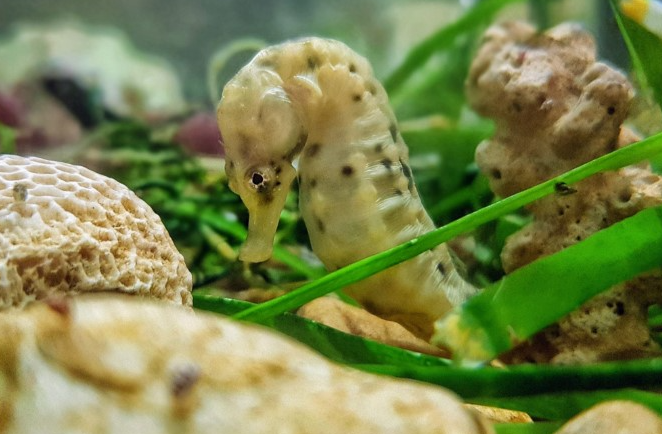
Codium, previously common in sections of Thesens Island Marina, was largely absent in areas where it once formed dense beds. In its place, there were patches of bare sediment, with seahorses clinging to whatever isolated vegetation remained, or simply resting on the bare sand.

This change speaks to a loss of structure in the environment, and for a species like the Knysna seahorse with their poor swimming ability, structure is survival. We asked ourselves, is this a seasonal or directional change? Only repeated monitoring will tell.

Underwater vegetation is shifting in the Knysna Estuary 

Elsewhere, Cape eelgrass appears to be giving way to strap Caulerpa in some areas, while in others it is expanding into spaces once occupied by spiral ditchgrass.

These are not random movements. 

They suggest underlying shifts in environmental conditions; the latter possibly linked to salinity changes influenced by freshwater use upstream. If that is the case, then what happens on land is quietly reshaping life below the waterline.

The presence of alien species adds another layer of concern. The red seaweed Asparagopsis and spaghetti bryozoans are now a regular feature in many parts of the estuary.

Their spread may seem gradual, even unremarkable, but invasive species rarely announce their impact immediately. They can alter habitats over time, often in ways that are difficult to reverse.

ALSO READ: Mokgosi reshuffles North West Cabinet, moves Mohono into Education

Even the physical conditions of the estuary are not immune to change. During one dive, water temperatures dropped to 11 degrees Celsius due to coastal upwelling. Such events may be natural, but they influence behaviour. 

Cuttlefish, usually elusive, moved slowly and remained within easy reach, revealing how environmental shifts can alter the rhythm of marine life.

Together, these observations challenge the idea of the estuary as a stable, predictable system.

Instead, they point to something far more complex. A living environment shaped by seasonal cycles, human influence, and the steady arrival of species from elsewhere.

At what point do these changes move from natural variation to something that demands intervention?

Monitoring alone is not enough if it is not paired with clear decisions about what should be protected, restored, or managed differently.

Protecting one of the world’s last Knysna seahorse populations 

The Knysna Estuary is home to one of only three populations of Knysna seahorses in the world. It has the most stable population of Knysna seahorses of the three host estuaries, with a water area three to five times larger than each of the other two systems. These facts alone should give us pause. 

When a system is this dynamic and a species this vulnerable, there is little room for complacency.

What lies beneath the surface is not just scientific curiosity. It is a reminder that even the most familiar landscapes are in flux.

The real challenge is whether we are paying enough attention to notice, and whether we are prepared to respond when the evidence asks us to.

Clement Arendse is a SANParks scientist based in the Garden Route National Park. 

INSIDE METROS

-Advertisement-spot_img

More articles

LEAVE A REPLY

Please enter your comment!
Please enter your name here

Inside Education Quarterly Print Edition

spot_img

CATHSSETA

spot_img

QCTO

spot_img

AVBOB STEP 12

spot_img

Inside Metros G20 COJ Edition

spot_img

JOZI MY JOZI

spot_img

Inside Education Quarterly Print Edition

spot_img

Latest article