-Advertisement-spot_img
spot_img

EFF says Tshwane is one shock away from failing to pay workers

Must read

By Johnathan Paoli

The Economic Freedom Fighters (EFF) says the City of Tshwane is “one shock away” from being unable to pay its workers, citing the metro’s weak liquidity, water and electricity losses, irregular expenditure and deteriorating infrastructure.

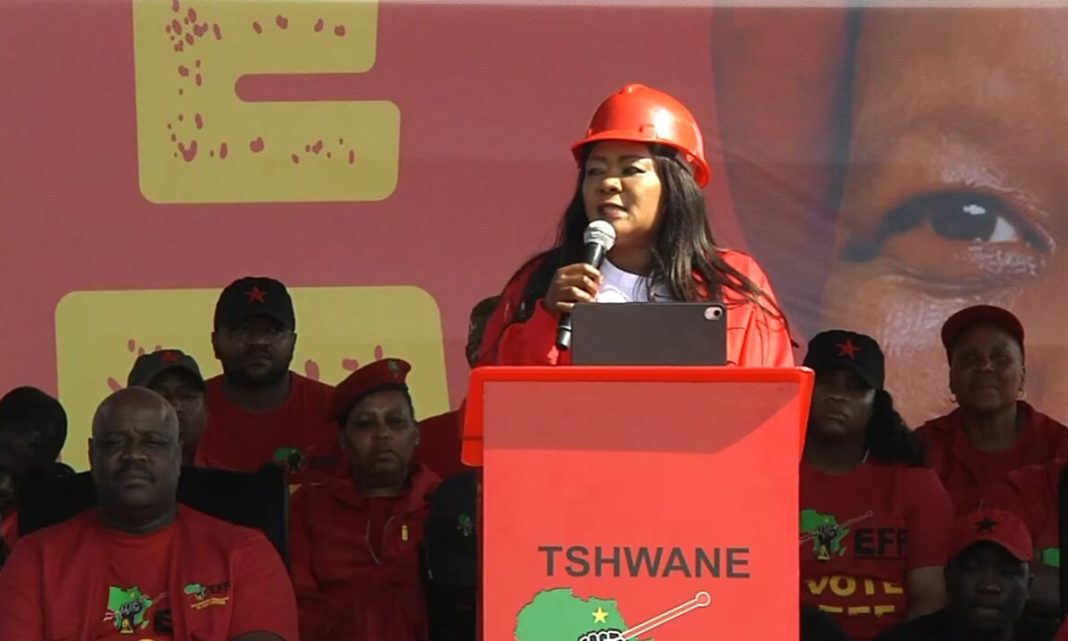
Speaking at the party’s 2026 local government election manifesto launch at Bana Sports Ground in Mabopane on Saturday, EFF Treasurer-General Omphile Maotwe criticised ActionSA mayor Nasiphi Moya and accused her of personal spending despite the state of the city.

“At the end of June 2026, Tshwane had only R1.6 billion in cash. This capital city, the seat of our national government, is one shock away from being unable to pay its own workers,” Maotwe said.

“But we’re not surprised by this because the ActionSA mayor is busy with the construction of her own swimming pool, allegedly using money from service providers doing business with the city, the same way we saw former president Jacob Zuma building a swimming pool using state money and calling it a fire pool. We are once again witnessing the same kind of corruption.”

Maotwe accused Tshwane of losing billions of rands through water and electricity losses, saying about R1.70 billion worth of water was lost during the past financial year, representing 39.1% of the water purchased.

She said the metro lost a further R1.87 billion in electricity, equivalent to about 21% of the electricity purchased, because of illegal connections, tampered meters and infrastructure losses.

Maotwe said Tshwane recorded R943.3 million in irregular expenditure in the past financial year, blaming procurement delays and contracts that had been allowed to expire.

“Every day a tender is delayed is a day a pothole stays open, a sewer keeps leaking, and a mother keeps carrying water on her head because the pipe meant for her house is still sitting in a file on somebody’s desk,” she said.

She said Tshwane’s problems were particularly unacceptable because it was the country’s capital and had significant economic and diplomatic assets.

Maotwe pointed to the metro’s industrial base, including vehicle manufacturers in Rosslyn and Silverton, its Gautrain stations and Wonderboom Airport. She argued that the city had substantial economic potential despite its service-delivery failures.

“A capital city with this much promise, this much international standing and this much economic potential has no excuse to leave its own people fetching water in the dark, queueing at clinics before dawn, or living behind an illegal wire in the name of electricity,” she said.

Maotwe also highlighted what she described as achievements during the EFF’s participation in Tshwane’s coalition government. These included the reinstatement of 81 municipal workers, the relocation of 500 flood victims from Mamelodi to Leeuwfontein and the cancellation of R4.3 billion in water and electricity debt owed by more than 85,000 poor households.

She claimed EFF councillors had also helped scrutinise R14.9 billion in historical irregular, unauthorised, fruitless and wasteful expenditure.

Maotwe said the number of material irregularities flagged by the Auditor-General had fallen from 14 to two.

However, she acknowledged that Tshwane remained in a precarious financial position and said residents were being asked to pay more despite persistent service failures.

She highlighted increases of 5% in property rates, 8.8% in electricity tariffs, 10% in water tariffs, 5% in sanitation charges and 4.1% in refuse-removal charges.

The EFF promised to address the problems through a programme focused on infrastructure maintenance, revenue recovery and rebuilding the municipality’s internal capacity.

Among Maotwe’s key proposals was a Ward Delivery Plan that would set out the cost, budget allocation, responsible department, implementation date and quarterly progress of major projects in every ward.

She promised to insource security, cleaning, waste collection and maintenance work while rebuilding municipal teams of engineers, artisans and technicians.

On water, the EFF pledged to end Hammanskraal’s reliance on tankers and rebuild the Rooiwal Wastewater Treatment Plant.

Maotwe also promised to formalise informal settlements, extend clinic operating hours, accelerate the issuing of title deeds and investigate irregular expenditure to recover stolen funds.

She said at least 40% of municipal jobs would be reserved for young people aged between 18 and 35, while at least 50% of procurement opportunities would be allocated to youth-owned businesses and cooperatives.

She also pledged that women would have at least 50% representation in municipal leadership and procurement.

The manifesto launch came as the EFF sought to frame the November election as a referendum on service delivery rather than immigration.

“No ward councillor and no mayor controls our borders. Local government is about service delivery, and we will not let anyone distract this capital city from the crisis of governance that only your vote can change,” Maotwe said.

The EFF said its candidates had signed declarations committing themselves not to engage in corruption, conduct business with the municipality, manipulate housing or employment processes, or tolerate gender-based violence.

Maotwe said candidates who violated the pledge would be removed.

The party ended its manifesto launch by presenting candidates for all 107 Tshwane wards and calling on residents to vote for the EFF on November 4.

INSIDE METROS

-Advertisement-spot_img

More articles

LEAVE A REPLY

Please enter your comment!
Please enter your name here

Inside Education Quarterly Print Edition

spot_img

CATHSSETA

spot_img

QCTO

spot_img

AVBOB STEP 12

spot_img

Inside Metros G20 COJ Edition

spot_img

JOZI MY JOZI

spot_img

Inside Education Quarterly Print Edition

spot_img

Latest article