
By Lebone Rodah Mosima
Democratic Alliance (DA) leader and Cape Town mayor Geordin Hill-Lewis has warned that the party’s majority in the city is not guaranteed, describing the election as tight and urging supporters to turn out to vote.
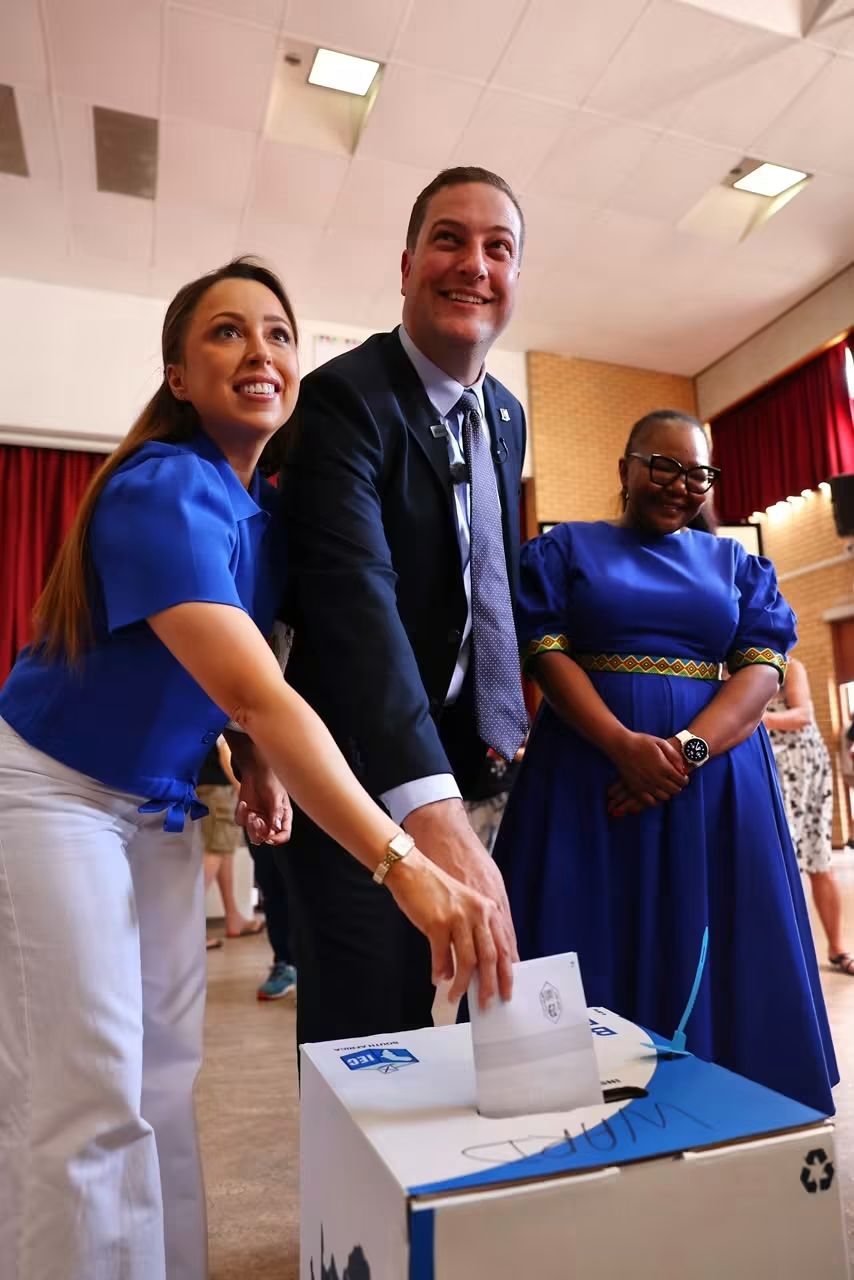
Addressing the media at Edgemead Primary School on Wednesday, Hill-Lewis said the DA would retain its majority only if every DA supporter in Cape Town cast their ballot.
“It is absolutely not a sure thing. It’s tight in the polls,” he said.
Hill-Lewis said he was voting for the DA to take the city forward and send a strong signal of positive change across South Africa.
Responding to criticism from opposition parties ahead of a possible re-election as mayor, he said he distinguished between criticism intended to improve the city and what he viewed as political manoeuvring.
“Whenever you get criticism you try to discern between that criticism which is well-meaning and comes from a place of actually wanting better for the city and that criticism which is just politicking and which is trying to mobilise their own supporters in their own base,” he said.
“I always reflect on the ideas and proposals of people who I really like and respect.”
He cited his work with people such as Roger Solomon, saying he would continue to consider criticism genuinely intended to benefit Cape Town.
“I’ll always take on board serious well-meaning criticism that means the best for the people of Cape Town, but I’m afraid most of it is just politicking and so that’s a bit like water off a duck’s back,” he said.
Hill-Lewis urged DA supporters not to take the party’s progress over the past five years for granted, warning that the gains could easily be reversed.
“Progress takes many years to build up and can be destroyed in an instant,” he said.
He called on DA voters to unite behind the party rather than split their votes among smaller opposition parties, which he referred to as “manure parties”.
On the possibility of governing through a coalition should the DA lose its majority, Hill-Lewis said the party would do so if necessary, although he hoped it would not come to that.
“Of course we will if that is necessary. I sincerely hope it will not be necessary and it won’t be necessary if everyone comes out and votes DA,” he said.
Turning to crime, Hill-Lewis said it was likely to be among the biggest concerns for Cape Town families, describing crime in South Africa as being “really out of control”.
He said the city had invested heavily in increasing the number of officers on the ground, particularly in communities hardest hit by gang violence and crime.
“We have really just poured resources into more boots on the ground into the most worst affected communities in the city with gang violence and crime,” he said.
He added that the DA had proposed what he described as a credible plan to tackle crime through expanded policing powers, additional resources and investment in crime-fighting technology.
Hill-Lewis also highlighted the city’s policing record over the past five years, claiming that 1,300 additional officers had been deployed during his tenure. He described this as the largest investment in Cape Town’s policing capacity since the establishment of the Metro Police.
He further argued that Cape Town performed better than other South African cities on independent measures.
“On every independent metric, not our metrics, but on every independent metric Cape Town stands head and shoulders above every other city in the country,” he said.
Describing Cape Town as the country’s most successful and functional city, he said voters faced a choice between maintaining progress and risking a reversal.
“Every election comes down to a simple choice between two directions: do you want to go forwards or do you want to risk going backwards in the rest of South Africa’s cities?” he said.
Despite the challenges facing the city, Hill-Lewis said Cape Town was moving forward and expressed hope that voters would consider this when casting their ballots.
On the DA’s prospects in other metropolitan municipalities, Hill-Lewis cautioned against placing too much confidence in political polls, saying they were subject to margins of error.
He nevertheless said independent polls, including those conducted by eNCA, News24 and SRF, showed the DA leading in several metros.
He identified eThekwini as an exception, saying the uMkhonto weSizwe Party (MKP) was leading there.
Hill-Lewis said the possibility of the DA making significant gains across the country’s metros could be historic, but cautioned that the election results would ultimately determine whether the polls were accurate.
“The only poll that counts is the one happening behind me right now,” he said.
He also expressed optimism about the possibility of a “blue wave” across South Africa, again urging DA supporters to turn out.
“Again I must emphasise it will be a blue wave if everyone turns out to vote for the DA. Please don’t stay at home,” he said.
On concerns about voting operations, Hill-Lewis said the process appeared to be running smoothly across Cape Town and the country following problems during Monday’s special voting.
He acknowledged that some votes had been lost during the process.
“There were definitely some votes lost on Monday,” he said, adding that the problems appeared to have been resolved.
He said voting machines were working and queues appeared to be moving quickly, expressing hope that voters would be able to cast their ballots without further difficulties.
Addressing Cape Town’s housing crisis, Hill-Lewis said increasing the supply of housing was essential to making accommodation more affordable.
He argued that building more housing developments was the only sustainable way to ease prices and increase the availability of affordable accommodation.
“You cannot both be in favour of more affordable housing and opposed to building more things. Those two are mutually exclusive positions,” he said.
He said the city needed to remove unnecessary red tape that restricted new housing developments.
“We have to ease the red tape strangulation on new supply and I’ve tried to tackle that most seriously in this last term and will keep attacking every piece of unnecessary red tape relentlessly until it is easier to provide more affordable accommodation in Cape Town,” he said.
Another priority, he said, was releasing more city-owned land for development.
Hill-Lewis claimed that the city had released more municipally owned land during his current term than at any other time in its history, with several projects that had previously stalled now under construction.
He cited developments in Salt River as an example of projects that had finally moved forward.
He said the city’s planning priorities also included addressing the legacy of apartheid spatial planning, which remained entrenched in South African cities.
This would require delivering more affordable housing, releasing state-owned land and improving public transport, he said.
“All of those ways are ways in which you dismantle and unstitch that legacy bit by bit,” he said.
INSIDE METROS