By Lebone Rodah Mosima
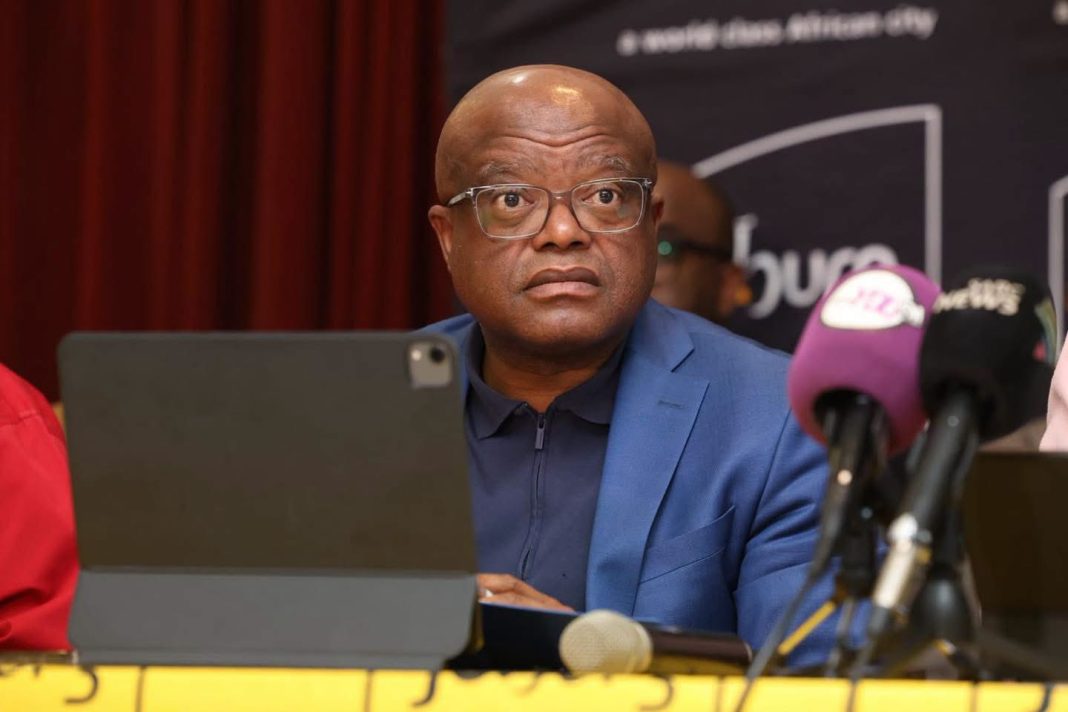
Some Johannesburg households have been without water for more than 10 days as the city’s supply crisis continues, with Mayor Dada Morero acknowledging that labour disputes, leaking infrastructure and restrictions imposed by bulk supplier Rand Water have delayed efforts to restore services.
Speaking at a media briefing on Tuesday, Morero said large parts of Johannesburg had experienced severe water outages and low pressure since 19 October, leaving residents facing a second week of disruptions.
“Residents are now in their second week of disruption, and some households have had dry taps for more than 10 days,” Morero said.
“We acknowledge the frustration this has caused. Restoring a reliable water supply remains our priority.”
He said Rand Water was already pumping at full capacity and had warned that municipalities exceeding their allocated water volumes would face supply restrictions.
Johannesburg’s reservoirs have struggled to recover because consumption continues to outpace replenishment, with higher-lying neighbourhoods experiencing some of the worst disruptions.
Some reservoirs, including Hursthill, remain bypassed because of leaks, while industrial action at Johannesburg Water has also hampered recovery efforts.
“Labour action at Johannesburg Water also delayed the interventions needed to stabilise the system,” Morero said.
Despite the continuing outages, the mayor reported a modest improvement in the city’s overall water storage levels, which increased from 37% on Monday to 41% on Tuesday.
Johannesburg Water is adjusting flows, bulk meters and network pressures to direct available supply towards areas experiencing shortages.
However, Morero said that these interventions could result in further temporary interruptions and reduced pressure as the utility attempts to stabilise the network.
“Restoration is being managed gradually so that we do not overwhelm the network or drain recovering reservoirs, and teams are releasing trapped air from pipelines to clear airlocks that restrict flow.”
The situation remains particularly difficult in several parts of Johannesburg, including Parktown, Midrand, Randburg and Sandton.
In the Commando system, which supplies several western and central suburbs, Brixton Reservoir 1 has recovered to approximately 91% capacity, while Brixton Reservoir 2 is at about 50%.
Johannesburg Water has increased flows through the Hursthill 2 interlink to improve supply to Crosby, Brixton and Hursthill.
However, Parktown Reservoir remains critically low, with teams attempting to improve inflows.
Yeoville Reservoir has recovered to above 40%, allowing supply to resume, while Berea Reservoir improved to more than 60%.
In Sandton, overall storage increased from 27% to approximately 37%, although supply remains under pressure.
Bryanston and Illovo pumping stations are operating on bypass, with Bryanston, Illovo and Morningside still requiring active intervention.
Conditions remain difficult in Midrand, where Grand Central Reservoir is at very low levels and pumping to its tower has been suspended.
Erand Reservoir has recovered to approximately 35%, improving supply to Kyalami, Noordwyk and Vorna Valley, although inflows remain insufficient.
Ivory Park, Allandale and Kaalfontein continue to experience supply challenges despite President Park Reservoir reaching approximately 67%.
In Randburg, Honeydew continues to experience extremely low inflows and reservoir levels, affecting Sundowner, Northriding and Northgate.
Technical teams have been deployed to investigate the problem.
Parts of Cosmo City also remain affected, although restrictions have been lifted and reservoir levels are recovering.
In Soweto and southern Johannesburg, network adjustments designed to support recovery at Rand Water’s Meredale Reservoir disrupted supply to Power Park, Chiawelo, Protea Glen, Meadowlands, Zondi, Noordgesig, Diepkloof Extension, Eldorado Park and Pimville.
Morero said throttling had since been lifted and the affected reservoirs were recovering.
The prolonged disruptions come as the South African Human Rights Commission released findings on the water crisis in Gauteng on Tuesday.
In its report, the commission found that sufficient water resources were available to meet current demand, but billions of rands were being lost through leaking infrastructure, while municipalities increasingly relied on water tankers instead of investing in permanent solutions.
Johannesburg alone loses approximately 44.8% of its water, valued at R2.82 billion annually, while Tshwane loses 39%, worth R1.7 billion.
“The availability of water at source does not, by itself, ensure that communities receive water that is safe, sufficient and reliably available at the point of use,” the report stated.
It also criticised the government’s reliance on meetings and recovery plans without measurable improvements, declaring: “Put simply, another meeting will not fix the pipe,” it said.
The SAHRC made eight overarching recommendations, including urgent repairs to failing wastewater treatment plants, improved maintenance of water infrastructure, filling critical technical vacancies and strengthening municipal financial accountability.
It called for tighter regulation of water tankers, including water quality and cost controls, while municipalities work towards permanent piped infrastructure.
The commission also recommended protecting infrastructure against theft and vandalism, improving reservoir storage and bulk-water supply reliability, and rehabilitating polluted rivers and wetlands.
Municipalities must account for irregular and wasteful expenditure, while financially distressed councils should seek National Treasury assistance.
The SAHRC said it would monitor implementation and consider legal action where its recommendations were ignored.
Morero welcomed the recommendations and said the city would engage Johannesburg Water on implementing them.
The mayor also announced progress in plans to reduce Johannesburg Water’s reliance on private water tanker contractors.
The utility is building a municipally owned fleet, following a council resolution in the 2023/24 financial year to bring the service in-house.
Twenty tankers purchased during the 2024/25 financial year are operational, while another 16 have been procured.
Of those, six are operational, five have been delivered and are being prepared for service this month, and another five are expected during the 2026/27 financial year.
A further 20 tankers are planned across the 2026/27 and 2027/28 financial years.
The eventual fleet of about 60 vehicles is intended to replace contracted tankers providing daily services to informal settlements.
Morero said savings from the programme would be redirected towards projects designed to reduce water losses, bulk purchases and consumption.
INSIDE METROS