
By Johnathan Paoli
EFF leader Julius Malema has outlined plans to address water shortages and deteriorating road infrastructure in communities where the party has secured ward victories, saying that municipalities should not use bureaucratic restrictions as an excuse for failing to deliver basic services.
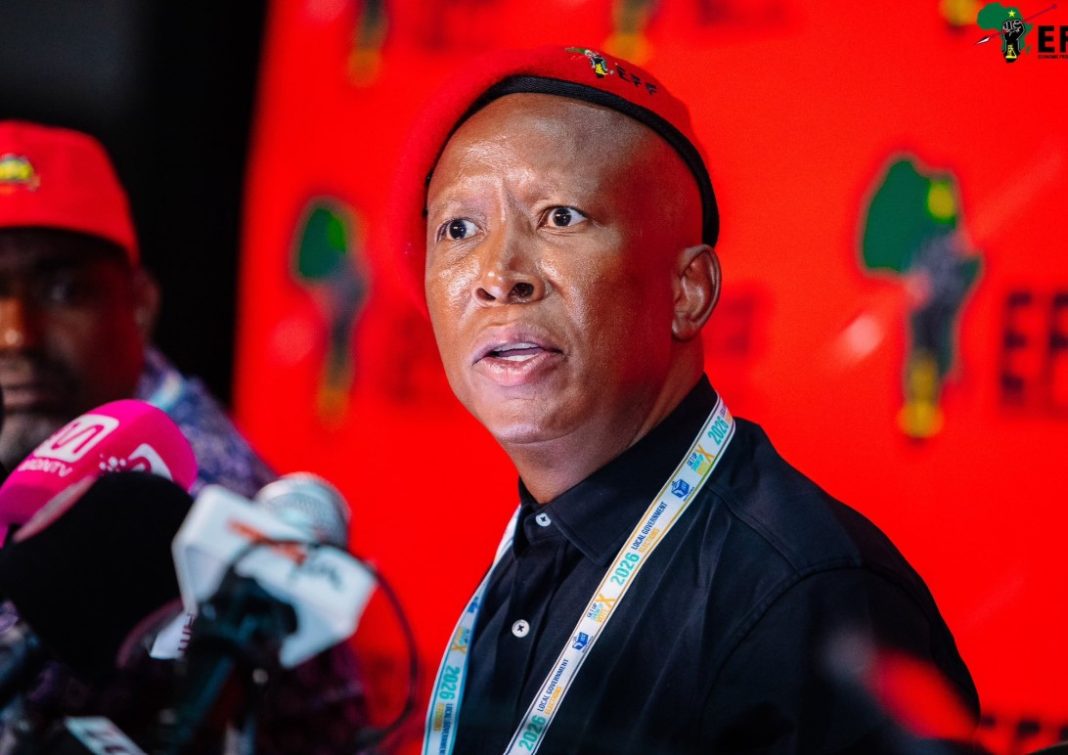
Speaking during a media briefing on Saturday following the 2026 local government elections, Malema identified infrastructure challenges in Limpopo communities, where he said residents continued to face difficulties accessing properly connected roads and reliable water supplies.
He said the EFF intended to use its newly secured ward positions to demonstrate that councillors could take practical steps to improve residents’ lives without necessarily holding mayoral or executive positions.
“Why should people not have water in a ward of the EFF, where the councillor of the EFF is there?” Malema asked.
He said the party would direct resources towards its 37 wards and introduce interventions aimed at addressing immediate community needs over the next 100 days.
One of the problems he highlighted concerned road infrastructure and the division of responsibilities between provincial and municipal authorities.
Using an example from a ward in Limpopo, Malema said residents were confronted with a gap between a provincial regional road and an internal municipal road, with the municipality allegedly unable to address the problem because of restrictions around the different road authorities’ responsibilities.
“In one of the wards we won, in Blood River towards Mahoe and Polokwane, you find that there is a road that is owned by the province, and then the municipality does an internal road. But that internal road, between that internal road and the regional road, there is gravel. And the explanation is that the regional roads cannot be touched by the municipal roads,” he said.
READ: Malema blames ANC-DA coalition for strengthening ‘white supremacy’ as EFF reels from election losses
Malema questioned why municipalities could not intervene to connect the roads through paving, arguing that residents should not be left dealing with inaccessible infrastructure because of administrative boundaries.
He added that the party would challenge any attempts to prevent its councillors from implementing such interventions, including through legal action.
Water provision was another major concern raised by Malema, who proposed that the EFF investigate the installation of boreholes on councillors’ properties as an immediate measure while communities continued waiting for formal piped-water infrastructure.
“Let’s drill a borehole inside the yard of the councillor, put all the facilities inside the yard of the councillor, then take a tap out,” he said.
He suggested that water could subsequently be piped to different voting districts and surrounding communities.
Malema estimated that the proposed boreholes could cost between R60,000 and R80,000 each, depending on the expense involved, and said the party would consider the intervention across its wards.
He said the proposals formed part of a broader commitment to demonstrate accountability to communities that had voted for the EFF, arguing that political representation should translate into visible improvements in service delivery.
The comments came as the party acknowledged losing 612,326 votes nationally compared with the 2021 local government elections, while increasing its ward victories from 19 to 37.
Malema said the EFF would use its electoral gains to establish a deliberate programme of service delivery, particularly in communities where residents had become disillusioned with voting because they did not see improvements in their living conditions.
He said that political parties should accept responsibility for communities even when they were not formally controlling municipal administrations.
INSIDE METROS