
By Thapelo Molefe
Democratic Alliance (DA) federal leader Geordin Hill-Lewis has vowed to fix Tshwane’s failing water system, tackle corruption and improve basic services, saying residents should not have to rely on water tankers while the city’s infrastructure continues to deteriorate.
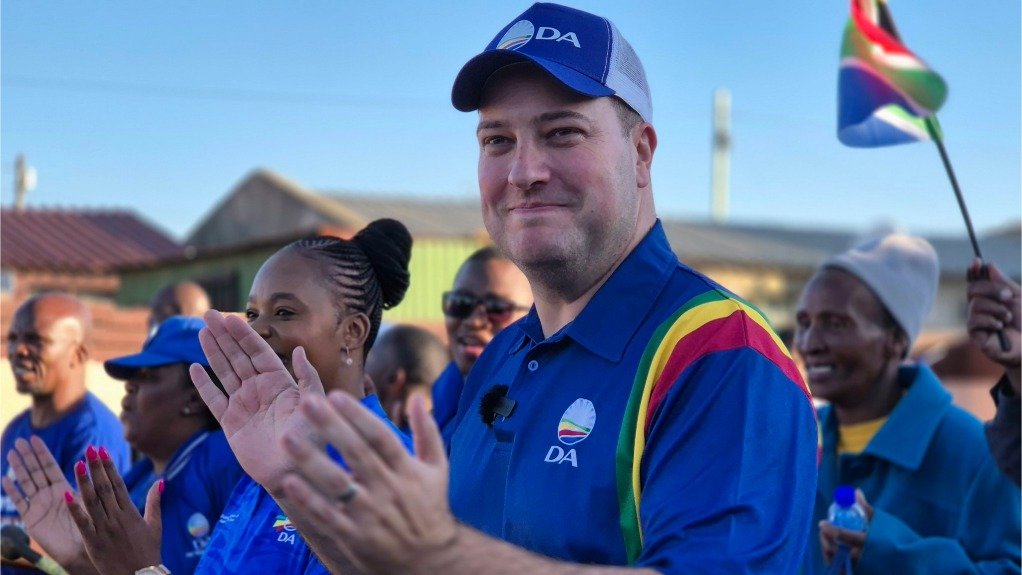
Launching the DA’s Working For All Tour in Tshwane on Tuesday, Hill-Lewis said the party would focus on ensuring residents have reliable water and electricity, safer communities, functioning infrastructure and professional municipal services.
The tour forms part of the DA’s campaign ahead of the local government elections and will take Hill-Lewis to five metropolitan municipalities: Tshwane, eThekwini, Ekurhuleni, Nelson Mandela Bay and Johannesburg.
Hill-Lewis said Tshwane’s water crisis demonstrated how poorly the municipality was being managed, pointing to the amount of money being spent on water tankers instead of repairing and upgrading the city’s water infrastructure.
He said Tshwane spent R777 million on water tankers during the 2025 financial year, while a further R120 million in invoices was reportedly being processed over possible fraud.
“A water tanker should be an emergency solution,” Hill-Lewis said.
“Here water tankers have become the water system and every rand that is spent on trucking water is not spent on fixing the pipes and actually fixing the water system so that your taps can work properly.”
Hill-Lewis said the DA would ring-fence revenue collected from residents for water and electricity to ensure it was used to maintain and upgrade those services.
The plan includes fixing leaks, replacing ageing pipes, upgrading pumps and bringing engineers and technical professionals back into the municipality.
Where the city lacks the money or expertise required to build infrastructure, Hill-Lewis said the DA would pursue private investment and partnerships.
“We will ring-fence all the revenue from water and electricity for maintaining and investing in water and electricity,” he said.
The DA leader also promised to clean up Tshwane’s procurement system and remove officials involved in corruption.
“If you want to do business with a DA municipality you better be able to actually do the job. It doesn’t matter if you know the politician who’s in charge,” he said.
Hill-Lewis said the DA would appoint qualified people, implement professional procurement processes and hold officials accountable for corruption and poor performance.
He also blamed the city’s political instability for making it difficult to address service delivery problems.
Tshwane’s current government consists of 11 political parties, which Hill-Lewis described as “coalition chaos”.
“Your current city government contains 11 political parties. You can’t even put it on two hands. 11 parties, 11 sets of egos and interests and conflicting opinions,” he said.
Hill-Lewis singled out the ANC, EFF, ActionSA and Freedom Front Plus, accusing the parties of fighting among themselves while residents wait for basic services to be restored.
“The ANC, the EFF, ActionSA, the Freedom Front Plus, they’re all fighting with each other. Meanwhile you and the residents of Tshwane are sitting at home wondering when someone is going to come and fix the water, when is someone going to come and fix the road,” he said.
He said the dispute over Tshwane city manager Johann Mettler’s suspension was an example of the political instability.
According to Hill-Lewis, the EFF pushed for Mettler’s suspension, the ANC backed it, while ActionSA supported the suspension behind closed doors before opposing it publicly. He also accused the speaker of excluding 13 DA votes from the vote, a matter he said the DA successfully challenged in court.
DA Tshwane mayoral candidate Cilliers Brink also criticised the current administration, saying the city had regressed since the DA was removed from office.
Brink said the problems extended beyond service delivery and were affecting jobs and the local economy.
“A municipality that falls apart also means that people lose their jobs,” Brink said.
He claimed Tshwane lost 85,000 jobs between April 2025 and April 2026, linking the losses to power and water cuts, poor infrastructure and municipal spending that did not provide value to residents.
Brink outlined three priorities for a DA government: fighting corruption, using technology to improve public safety, and working with private companies to improve electricity, water, street lighting and waste collection.
He said the party would use cameras and control rooms to monitor Tshwane Metro Police officers and vehicles and improve cooperation with private and community security.
Brink also proposed performance-based contracts for municipal services, where contractors would be paid according to whether the services they were hired to provide actually worked.
“South Africans don’t care who actually fixes the pipes, who fixes the electricity. They don’t care. They just want those services to work, and they want value for the money that they are already paying,” he said.
DA federal chairperson Solly Msimanga said the party wanted to replace temporary solutions such as water tankers and mobile toilets with permanent infrastructure.
“We don’t want temporary solutions anymore. We want permanent solutions that give people a dignified life,” Msimanga said.
Hill-Lewis said the DA would use the tour to show voters what it believes functioning local government should look like.
“We’re not saying believe us, we’re saying look at what we have done. We fix things, we have fixed things, we are fixing things and we will fix things. Look at our track record,” he said.
He said the goal was to create municipalities that provide reliable services and support local economic growth.
“Working governments should belong to everyone,” Hill-Lewis said.
INSIDE METROS