
By Lebone Rodah Mosima
The KwaZulu-Natal Department of Cooperative Governance and Traditional Affairs (CoGTA) has provided firefighting equipment to six municipalities identified as being at high risk of fires as the province prepares for the summer disaster season.
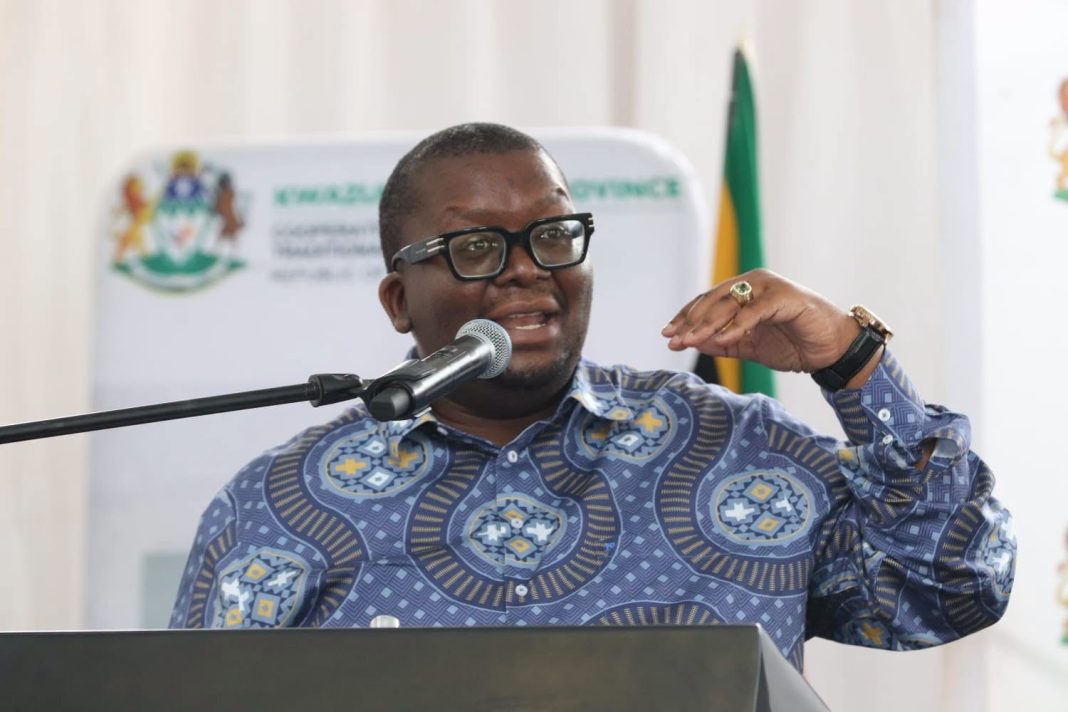
Speaking in KwaMngomezulu Sportfield, Nkandla, on Tuesday, CoGTA MEC Thulasizwe Buthelezi said the department was implementing programmes aimed at improving people’s lives and strengthening disaster preparedness.
“This government, led by our honourable Premier Ntuli, carries the slogan of restoring hope to the people of KwaZulu-Natal, because year after year they were neglected until 2024, when they stated through their vote that they wanted change,” Buthelezi said.
He said the department’s repeated visits to Nkandla demonstrated its commitment to addressing the municipality’s developmental challenges and ensuring residents benefited from government programmes.
“We bring development that will change the situation in many households here in Nkandla, so that these communities, mayor, may also see themselves as part of KwaZulu-Natal and that they are being cared for,” he said.
Referring to the legacy of the late Prince Mangosuthu Buthelezi, he said his vision was for people to develop within their communities rather than leave their homes in search of better opportunities.
“This is the vision that inspires us, which Prince Buthelezi left us with as leaders,” he said.
Buthelezi said the arrival of spring required government and communities to prepare for seasonal hazards, including floods, storms, lightning strikes and fires.
He referred to the International Day for Disaster Risk Reduction, observed annually on 13 October, as an opportunity to raise awareness about disaster preparedness and ensure municipalities had the resources to respond to emergencies.
“Our province is one of those most severely affected by disasters, with damage to property, people’s homes, and even the loss of lives,” he said.
He said the department, working with the Provincial Disaster Management Centre (PDMC), issued seasonal warnings to help communities prepare for potential disasters and minimise their impact.
He said more than 100 people died annually in KwaZulu-Natal as a result of disasters, adding that more than 1,000 people had died over the preceding three years in summer-related incidents, including floods, drownings in dams and rivers, lightning strikes and storms.
Buthelezi warned that forecast hot and dry conditions could threaten farmers, livestock owners and vulnerable people, particularly young children and older people.
He said meteorological organisations had warned of severe drought conditions associated with El Niño, which he described as bringing extreme heat, hot winds and reduced rainfall.
“This condition has already begun to impact KwaZulu-Natal because in recent days the sun has been extremely hotter than what we are used to,” he said.
He said the conditions were expected to persist until March 2027, potentially increasing the risk of water shortages and veld fires.
He urged municipalities to develop water conservation strategies and called on residents to conserve water, adopt farming methods suited to drier conditions and protect their livestock.
“Department of Agriculture officials will visit areas to also warn communities on what they can plant that will align with this condition and provide knowledge on livestock protection,” he said.
Buthelezi said Nkandla remained vulnerable to fires because of its forests and surrounding vegetation, which could burn and spread to residential areas, threatening homes and livestock.
He said the department had decided in 2024 to establish a disaster management centre in Nkandla because firefighters travelling from Richards Bay and Eshowe sometimes arrived after fires had destroyed homes and livestock.
“That is why when we arrived in this department in 2024 we made a decision that the Nkandla Disaster Management Centre must be built because most of the time when there is a fire here in Nkandla, firefighters have to come from Richards Bay and Eshowe, arriving when the fire has already swept through and destroyed people’s homes and livestock,” he said.
He said plans to build the centre were continuing and that young people were being recruited and trained to respond to fires.
As part of preparations for the summer season, the department was working with organisations, including the Development Bank of Southern Africa and insurance company Santam, to support municipalities identified as being at high risk of fires.
“Our disaster centre has purchased high-tech firefighting equipment, which we have brought here with us to Nkandla,” he said.
“This machinery and tools will be handed over to six municipalities we have identified as facing a high risk of dealing with fires.”
The six municipalities are Nkandla, Mfolozi, eDumbe, Nongoma, uMshwathi and Okhahlamba.
Buthelezi said the equipment needed to be operated by trained personnel.
“Before we purchased them, we took youth from different wards to receive training and knowledge on firefighting and emergencies,” he said.
He said certificates would also be handed over to those who had completed fire services and community training.
He said the initiative formed part of the provincial government’s commitment to delivering services without political discrimination.
Buthelezi also addressed electricity provision, saying access to electricity was essential for education, the use of modern technology and the growth of small businesses.
He said residents had previously raised concerns about households without electricity and that the department had committed to addressing the problem.
“I arrived here last year and people from Ward 4 complained that there were households without electricity,” he said.
He said 85 households in Maphumulo had since received electricity.
“We have not stopped with this; if we have not reached your area yet, know that we are coming, we are on our way,” he said.
Turning to employment, Buthelezi acknowledged that government and municipalities could not employ every job seeker.
He said the department’s Local Economic Development (LED) programme was designed to support people interested in establishing businesses.
“That is why in the Department of CoGTA we have a programme called Local Economic Development (LED) where we support people who have an interest in doing business,” he said.
He said the programme had been introduced in several municipalities, including uMhlabuyalingana, Jozini, Mtubatuba, Abaqulusi, Okhahlamba and Mzumbe.
He said some beneficiaries had expanded their businesses and created employment opportunities.
“We said Nkandla cannot be left out of this programme because even here there are young people who are committed and have already started working,” he said.
As part of the initiative, the department announced support for 30 entrepreneurs from different wards in Nkandla, providing equipment to help them establish or expand their businesses.
“Today we are leaving support for 30 people here in Nkandla coming from all wards, whom we are leaving with things to start businesses,” he said.
The beneficiaries comprise three groups of 10 people each.
Ten catering entrepreneurs are set to receive equipment, including chafing dishes, pots, stoves and serving utensils, to help them provide services at events, weddings and funerals.
Another 10 beneficiaries will receive industrial sewing machines to support clothing and school uniform production, while a further 10 young men will receive lawnmowers to establish or expand grass-cutting businesses.
Buthelezi said the initiative was intended to strengthen local businesses, create employment and stimulate economic activity in Nkandla.
He said the department wanted to help local businesses grow, create jobs and contribute to the local economy.
He also urged registered voters, particularly young people, to participate in the upcoming local government elections, saying municipal government played an important role in determining development and service delivery.
“This is everyone’s right, and it is important because this is where you voice your opinion on the manner in which development is brought to the area where you live,” he said.
He urged residents to elect honest leaders who would represent their interests and ensure municipalities delivered essential services, including water, electricity and roads.
“Even I am here today because of your vote, which you used to change how things happen in this province, and you put in this government led by Premier Ntuli, which stands up for people’s needs and cares for community welfare,” he said.
South Africa’s 2026 local government elections are scheduled for 4 November.
Buthelezi called on residents to turn out in large numbers, particularly young people, and elect leaders who would prioritise community needs and improve service delivery.
INSIDE METROS