By Lebone Rodah Mosima
Thulamahashe Magistrate’s Court in Mpumalanga registered 194 domestic-violence matters in just four months, a statistic Deputy Justice Minister Andries Nel said should concern everyone as South Africa continues to battle gender-based violence.
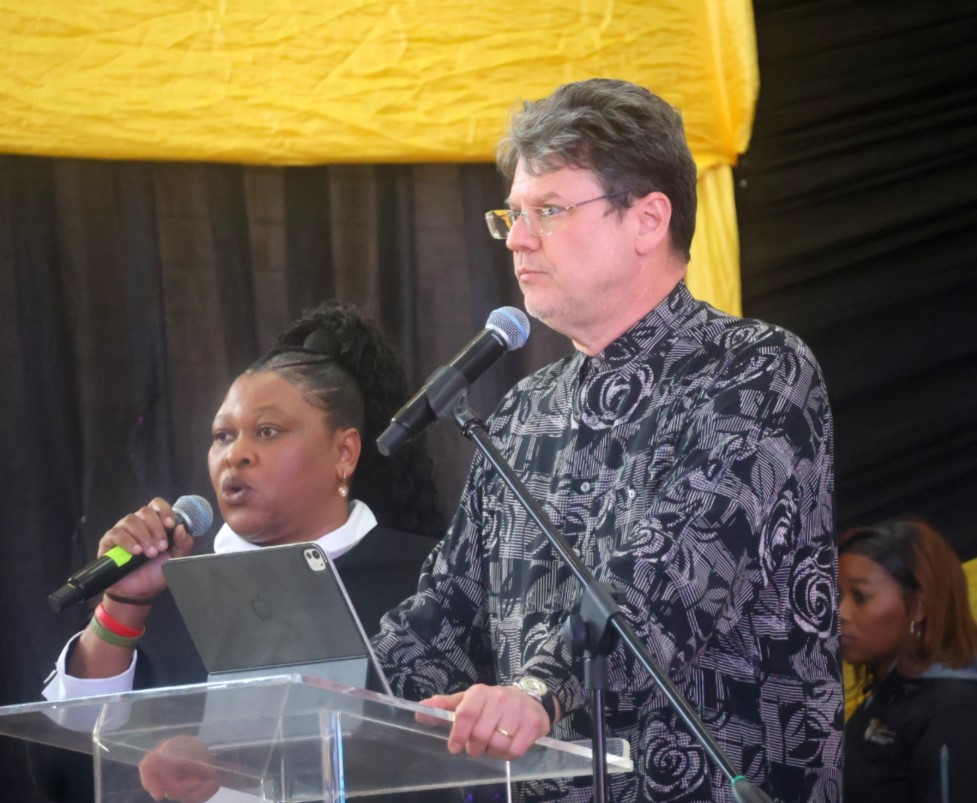
Nel disclosed the figures during his keynote address at the closing of Access to Justice Week 2026 in Thulamahashe, Bushbuckridge.
Between 1 April and 31 July, the court registered 194 domestic-violence matters, along with 98 maintenance matters, 38 Small Claims Court matters and 85 criminal matters.
“The number of domestic violence matters being dealt with here in Thulamahashe should concern every one of us,” Nel said.
He said gender-based violence could not be addressed by the Department of Justice and Constitutional Development alone, with police, prosecutors, magistrates, social workers, traditional leaders, schools, families, men and communities all having responsibilities.
“Our message must be unambiguous: Violence against women and children is not a “family matter” that society should ignore,” he said.
“It is not part of our culture. It is not something a woman must simply endure. It is a violation of her rights and dignity.”
Nel said the court statistics reflected the human consequences behind the justice system.
“Behind every one of those numbers is a human being. Behind a maintenance case may be a mother trying to buy food and school clothes for her child. Behind a domestic violence application may be a woman who has finally found the courage to ask the state to protect her,” he said.
“We must never allow case numbers to become simply statistics on a spreadsheet. Every file represents somebody’s life.”
Nel said Access to Justice Week had already resulted in approximately 500 people being assisted in Thulamahashe and surrounding communities, including New Forest, Songeni Village, Rolle, MP Stream, Kumani, Tsuvulani, Demulani, Eighteenburg, Landela, Wisani and Buyisonto.
“That tells us something important. People need justice services. But it also tells us something more important: Justice cannot simply wait for people to come to it,” Nel said.
“Sometimes justice must go to the people. That is what Access to Justice Week is about.”
He said access to justice should mean at least four things: justice must be close enough to reach, simple enough to understand, affordable enough to use and effective enough to make a difference.
The Thulamahashe District Court currently serves about 140,000 people in Thulamahashe, Islington and surrounding areas, while the Regional Court serves the wider Bushbuckridge sub-district, with a population of about 750,000.
“Those figures tell us why the location of courts matters. For someone with a car, travelling another 50 kilometres may be inconvenient,” Nel said.
“For someone who depends on a taxi and has R100 in their pocket, that distance can be the difference between obtaining justice and giving up.”
Nel said Thulamahashe, Acornhoek and Mkhuhlu were formally proclaimed as places for the holding of court under the Bushbuckridge sub-district in December 2024, with effect from February 2025.
“That may sound like an administrative decision in a Government Gazette. But its purpose is profoundly practical: to bring justice closer to where people live. And we must continue that work.”
He said access to justice could not depend on a person’s postal code and that people living in rural Mpumalanga had the same constitutional rights as those living in Johannesburg, Cape Town or Mbombela.
He said that a justice system could not be considered accessible if people could not understand it, particularly in a multilingual community where Xitsonga, isiNdebele, siSwati and English are widely spoken.
“Our responsibility as public servants and legal practitioners is not to demonstrate how much law we know. It is to help that person understand what they can do,” he said.
“That is why legal literacy is so important. A right that you do not know about is a right that is very difficult to exercise.”
Nel said justice must also be affordable and pointed to Legal Aid South Africa, Small Claims Courts, community advice offices and pro bono legal work as mechanisms that could help people exercise their rights.
“It does not say that this right belongs only to people who can afford lawyers,” he said, referring to the Constitution’s guarantee that everyone has the right to have disputes decided fairly by a court or another independent tribunal or forum.
“The justice system must provide remedies that are proportionate to people’s problems. That’s why Small Claims Courts matter. That’s why community advice offices matter. That’s why pro bono work by the legal profession matters.”
He said access to justice was also dependent on the quality of public administration.
He said people approaching court counters should not be unnecessarily sent from office to office, telephones should be answered, maintenance investigations carried out quickly, unnecessary trial postponements avoided, computer failures fixed and vacancies that affected services filled.
Addressing traditional leaders, Nel said the Constitution recognised traditional leadership and customary law, but that government, courts, traditional institutions and communities all had a responsibility to uphold human dignity, equality and freedom.
“There should therefore not be a competition between constitutional justice and community leadership,” he said.
“We should ask instead: How do we work together so that a person with a problem finds help as quickly and fairly as possible?”
Marking 30 years since the adoption of the Constitution, Nel said South Africa needed to confront the gap between possessing constitutional rights and being able to exercise them.
“That is the challenge of access to justice,” he said.
INSIDE METROS