By Charmaine Ndlela
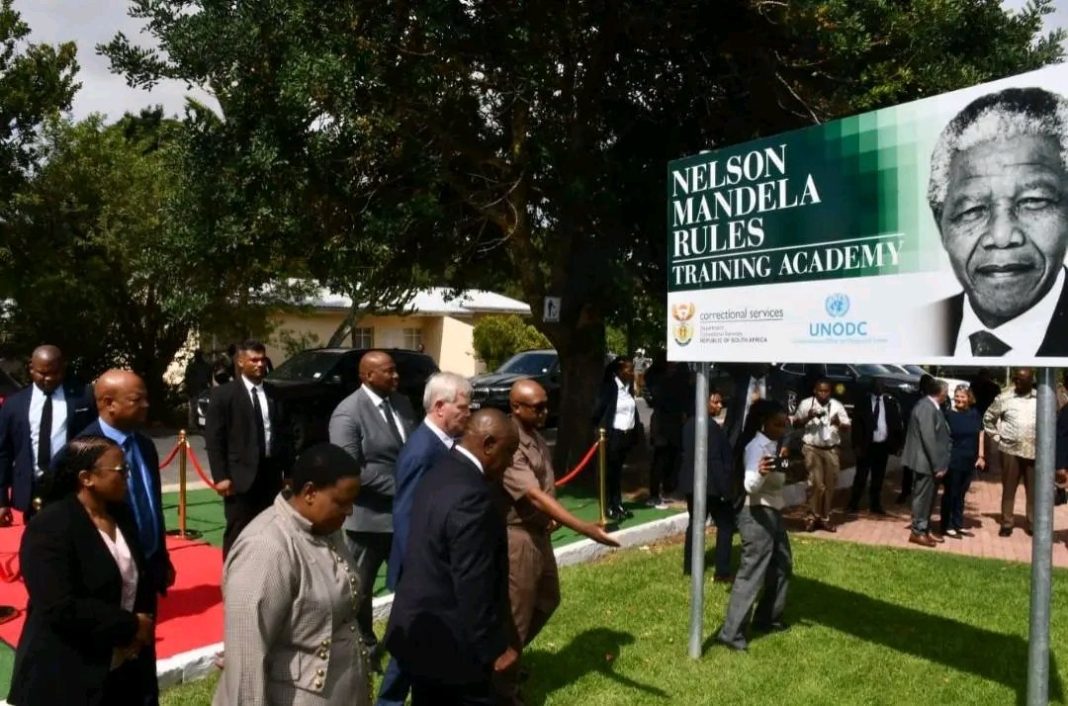
President Cyril Ramaphosa on Wednesday officially launched the Nelson Mandela Rules Training Academy at the Drakenstein Correctional Facility between Paarl and Franschhoek in the Western Cape, describing it as a new chapter in the country’s history.
Formerly known as Victor Verster Prison, the site was the last place Nelson Mandela was imprisoned before his release.
The academy — the first of its kind in Africa — marks a turning point in correctional services’ efforts to adopt and implement the United Nations Standard Minimum Rules for the Treatment of Prisoners, known as the Nelson Mandela Rules, adopted by the UN General Assembly in 2015.
The facility will serve as a centre for learning and rehabilitation aimed at strengthening correctional practice.
“Having spent 27 years in prison, Mandela championed the fair and humane treatment of all people. Mandela believed offenders deserve dignity, respect and humane treatment, and that justice is measured not by how harshly punishment is administered, but by how faithfully human dignity is upheld, even in difficult circumstances,” Ramaphosa said.
In his keynote address, the President said the rules promote humane conditions of imprisonment, emphasise rehabilitation, support educational and vocational training for inmates, and recognise the role of correctional staff.
“We are here to open a training centre that will carry Madiba’s name and carry forward his legacy of service, leadership and rebuilding,” he said.
The academy will serve South African officials and the broader global corrections community.
Ramaphosa noted that visitors are welcomed by artwork created by offenders. “This is not incidental. It is deeply symbolic. It reflects the very essence of rehabilitation. It is about unlocking human potential, creativity and self-worth,” he said.
He added that the furniture used in the academy was also produced by offenders within the correctional system. “Every table, every chair, every crafted piece speaks to the power of skills development, meaningful work and the desire for change.”
On the facility’s transformation, Ramaphosa said: “Today we open a repurposed, renovated and expanded facility transformed into a modern training academy. One cannot help but marvel at the quality of workmanship. It fills me with pride to appreciate work of such high standard being produced by local hands, by men and women within our correctional system.”
He said the academy would operate in partnership with the United Nations Office on Drugs and Crime, custodian of the Nelson Mandela Rules, to ensure that training, practice and policy are guided by Mandela’s values.
“This facility symbolises the humanisation of corrections, the elevation of dignity, and the global pursuit of justice rooted in humanity,” he said.
Paying tribute to correctional services officials, Ramaphosa said they operate under difficult and sometimes dangerous conditions.
“Their responsibility extends beyond custody and security. They are tasked with transforming lives and instilling hope where there is often despair.”
Acknowledging challenges such as overcrowding and resource constraints, Ramaphosa said he was encouraged by efforts to advance self-sufficiency, sustainability, skills development and productive work to ensure facilities become places of rehabilitation rather than mere containment.
The academy stands as a tribute to Mandela’s legacy and aims to shape generations of correctional practitioners committed to dignity and reform.
Last year, Correctional Services Minister Dr Pieter Groenewald revealed that more than 18,000 parolees had reoffended over the past three years, including committing serious crimes.
“Many lack basic financial stability. Because they have a criminal record, it is difficult, if not impossible, to find work. Many ex-offenders leave prison with untreated mental health and substance abuse problems. Rebuilding trust with family members and friends is perhaps the hardest challenge of all,” Ramaphosa said.
The centre was unveiled on the 36th anniversary of Mandela’s release from prison.
INSIDE METROS